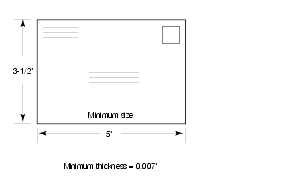
DMM TOC > 600 Basic Standards for All Mailing Services601 Mailability1.0 General Standards1.1 Minimum DimensionsFor mailability, the following standards apply: a. All mailpieces must be at least 0.007 inch thick. b. All mailpieces (except keys and identification devices) that are 1/4 inch thick or less must be: 1. At least 3‑1/2 inches high and at least 5 inches long. 2. Rectangular, with four square corners and parallel opposite sides (see Exhibit 1.1), unless prepared as Customized MarketMail under 705.1.0. [C010.1.1]
Exhibit 1.1 Minimum Dimensions, Pieces 1/4" Thick or Less 1.2 Maximum Dimensions and WeightNo mailpiece may weigh more than 70 pounds. Except for Parcel Post, no mailpiece may measure more than 108 inches in length and girth combined. For parcels, length is the distance of the longest dimension and girth is the distance around the thickest part. [C010.1.2] 1.3 Length and HeightThe location and orientation of the delivery address on a mailpiece generally establish which dimensions of the piece are the length and the height. The length is the dimension parallel to the address as read; the height is the dimension perpendicular to the length; the top and bottom of the piece are the upper and lower edges, respectively, when the address is positioned for normal reading. This general rule does not apply to: b. Standard Mail Enhanced Carrier Route flats. c. Standard Mail Customized MarketMail. d. Pieces thicker than 1/4 inch that are not prepared and mailed as a flat. [C010.1.3] 1.4 Nonmailable, Nonmachinable PlacementThe location of the delivery address on a letter‑size mailpiece determines which dimensions are the length and height of the piece. Consequently, the placement of the address may render a piece nonmailable or nonmachinable. [A010.1.4] 1.5 General Mailability and Right of RefusalArticles presented for mailing must be prepared under the general and specific standards in this document. The USPS accepts properly packaged and marked parcels but reserves the right to refuse nonmailable or improperly packaged articles or substances. Additional or other standards can apply to overseas military post offices and international mail. [C010.2.1] 1.6 Mailer's ResponsibilityIt is the mailer's responsibility to refrain from depositing nonmailable matter in the mail. The mailer must comply with applicable postal laws and regulations governing mailability and preparation for mailing, as well as nonpostal laws and regulations on the possession, treatment, transmission, or transfer of particular matter. Information about USPS standards is available from postmasters, business mail entry managers, and the PCSC manager (see 608.8.0, USPS Contact Information). [C010.9.3] 2.0 Packaging2.1 PreservationThe mailer must package the contents of a shipment to prevent deterioration or degradation. [C010.2.9] 2.2 Harmful, Fragile, and Heavy ItemsNo item may be packaged so that its contents could harm employees, equipment, or other mail. Fragile items must be packaged to withstand mail processing and transportation. Heavy items must be braced and cushioned to prevent damage to other mail. [C010.2.2] 2.3 StationeryStationery‑type items thicker than 1 inch or heavier than 1 pound are not accepted in letter‑style envelopes. The contents of these packages must be unitized by tying, banding, or using partitions on close‑fitting interior containers to prevent shifting. [C010.2.3] 2.4 LiquidsContainers of liquid with only friction‑top closures are generally not acceptable; screw caps, soldering, clips, or other means must be used for closure. Glass and other breakable containers of liquid with a capacity of more than 4 fluid ounces must be cushioned, with material sufficient to absorb all leakage in case of breakage, inside a sealed, waterproof container. Containers of liquid with a capacity of more than 32 fluid ounces are acceptable for mailing if cushioned as above and packaged within another sealed, waterproof container such as a can or plastic bag. The outer shipping container must be strong enough to protect the contents and must be marked to show the liquid nature of the contents. Steel pails and drums with carrying handles and positive closures, such as locking rings or recessed spouts under screw‑cap closures, may be accepted without additional packing. [C010.2.4] 2.5 AerosolsAerosols (i.e., containers under pressure) are hazardous materials and must be constructed to prevent accidental discharge of the contents during postal handling. Mailable aerosol containers must be packaged under 10.0, Hazardous Materials. [C010.2.5] 2.6 Infectious SubstancesInfectious substances (etiologic agents), clinical specimens, and biological products must be packaged and marked as specified in 10.0. [C010.2.7] 2.7 High‑Density ItemsHigh‑density items are defined as packages of solid objects other than books whose weight is comparatively high for their volume (e.g., hardware, machine and auto parts, tools). Such items weighing more than 15 pounds and packaged so that they exert no more than 60 pounds per square foot (0.4167 pound per square inch) pressure on the smallest side of the container are machinable. [C010.2.6] 3.0 Acceptable Containers3.1 Load TypeThe following three terms describe types of loads, based on the content, degree of protection, and strength of the package used: a. An easy load is one that contains items of moderate density that either completely fill the container or are packaged in interior containers that completely fill the outer mailing container. This load type is not readily damaged by puncture or shock and does not move within the package or present a hazard to other parcels. b. An average load is one that contains moderately concentrated items packed directly into a shipping container or that are subjected to an intermediate stage of packing and providing partial support to all surfaces of the container. This load type can be prepackaged by nesting items within partitions or in separate paperboard boxes to stabilize items and prevent shifting and damage. c. A difficult load is one that contains items that require a high degree of protection to prevent puncture, shock, or distortion to the items or the package. Fragile items, delicate instruments, and high‑density, small‑bulk items that do not support the mailing container are not acceptable in paperboard boxes, bags, or wraps. [C010.2.8] 3.2 EnvelopesEnvelopes may be used as containers for articles if the package can reasonably be expected to be processed and delivered without damage to the contents or other mail. Letter‑style (nongusseted flat) envelopes are acceptable as containers for nonrigid stationery and similar material, up to 1 pound and 1 inch thick. Larger or heavier envelopes are acceptable for easy loads up to 5 pounds if made from envelope paper equivalent to 28 substance weight or greater, or made from extra‑strength materials with a Mullen strength of more than 90 pounds per square inch. Envelopes for photographic film mailers or gusseted (three dimensional) envelopes are acceptable if made from envelope paper equivalent to 24 substance weight or greater. Envelopes may be used as containers for odd‑shaped items mailed at nonautomation Standard Mail rates, if the piece meets the standards for that class of mail. [C010.3.8] 3.3 BoxesBoxes are acceptable, subject to these standards: a. Paperboard boxes may be used for easy and average loads to 10 pounds. b. Metal‑stayed paperboard boxes may be used for easy and average loads to 20 pounds. c. Solid and corrugated fiberboard boxes may be used according to the limits in the following chart, unless otherwise specified. The first maximum reached governs the grade of the box used.
d. Wood, metal, or plastic boxes may be used for all types of loads, assuming adequate construction. e. The size of the box must be adequate to contain the items and provide enough space for cushioning material. f. Good, rigid, used boxes with all flaps intact are acceptable. g. Boxes with difficult loads to out‑of‑town destinations must be reinforced with banding about every 8 inches in each direction around the package. [C010.3.1] 3.4 Fiberboard Tubes and Similar Long PackagesFiberboard tubes and similar long packages are acceptable if their length does not exceed 10 times their girth. The strength of the tube ends must be at least equal to the tube sidewall strength, unless the contents are lightweight, rolled items. Sidewall strength is always equal to solid fiberboard 1/16 inch thick for tubes less than 18 inches long, 3/32 inch thick for tubes 18 to 32 inches long, and 5/32 inch thick for tubes more than 32 inches long. Crimped or taped end closures are not acceptable for other than lightweight rolled items. Tape must completely encircle the seams on friction slide closures of mailing tubes. [C010.3.9] 3.5 Paper Bags and WrapsFor easy loads of up to 5 pounds, paper bags and wraps are acceptable when at least of a 50‑pound basis weight (the strength of an average large grocery bag) and the items are immune from impact or pressure damage. A combination of plies adding up to or exceeding 50‑pound basis weight is not acceptable. For easy and average loads of up to 20 pounds, reinforced bags or bags with a minimum of 70‑pound basis weight are acceptable. Nonreinforced loose‑fill padded bags are not acceptable as exterior containers, unless the exterior ply is at least 60‑pound basis weight. [C010.3.3] 3.6 Plastic BagsPlastic bags must be at least 2 mil thick polyethylene or equivalent for easy loads up to 5 pounds; 4 mil thick for easy loads up to 10 pounds. [C010.3.4] 3.7 Plastic FilmHeat‑shrinkable plastic film—either irradiated polyethylene, linear low‑density polyolefin, or copolymer—must be at least 3/4 mil thick for an easy load up to 5 pounds, and 1‑1/4 mil thick for an average load up to 5 pounds. When requested, mailers must provide documentation that these types of film are being used for mailing. [C010.3.5] 3.8 Cloth BagsCloth bags are acceptable for easy and average loads of up to 10 pounds, if the seams of the bags equal the strength of the basic material. [C010.3.6] 3.9 Difficult LoadThe USPS does not accept bags, bales, or wraps with difficult loads. The contents in bags, bales, and wraps must be compressed when possible. [C010.3.2] 3.10 BalesBales are acceptable within postal weight limits, if adequately compressed and reinforced to contain the material. [C010.3.7] 3.11 Cans and DrumsCans and drums with positive closures are acceptable. Generally, friction closures alone are not acceptable. Protruding devices, such as locking rings, must be shielded by padding to prevent injury to USPS employees, equipment, or other mail. [C010.3.10] 4.0 Cushioning, Closure, Sealing, and Reinforcements4.1 VolumeLoose‑fill cushioning must overfill the container before closure to hold the item and prevent its movement to an outside surface of the container or to other items in the package. Shock and pressure forces must be dissipated over as much of the surface of the item as possible. [C010.4.1] 4.2 Several Items Within ContainerWhen several items are inside a package, they must be protected from each other as well as from external forces. Concentrated heavy items must not be packaged with fragile items unless extreme care is exercised to separate them from each other. Heavy items must be adequately stabilized. [C010.4.2] 4.3 TapeCellophane and masking tape may not be used for closure or reinforcement of packages but may be used to augment adhesive closures on envelopes or to cover staples on bags. [C010.5.1] 4.4 Paper TapePaper tape must be at least 60‑pound basis weight kraft. The adhesives on gummed tapes must be adequately activated before application and firmly applied with the tape extending at least 3 inches over the adjoining side of the box. [C010.5.2] 4.5 Tape SizeExcept for pressure‑sensitive filament tape, tapes used for closure and reinforcement may not be less than 2 inches (or 48 mm metric) wide. Nonreinforced plastic tapes must be at least as strong in the cross direction as in the machine (long) direction. [C010.5.3] 4.6 AdhesiveAdhesives for closure on box flaps or on tapes must remain serviceable from ‑20 degrees to +160 degrees Fahrenheit. Hot‑melt adhesive may be used if at least four strips are applied on each part of the box flap where the outer flap overlays the inner flap; each strip is 3/16 inch wide after compression; the strips are not more than 1‑1/2 inches apart, with the first strip no more than 1/2 inch from the center seam; and all strips are the full width of the inner flap, unless hot‑melt adhesive is applied to 25% of the area where the outer flap lies over the inner flap. [C010.5.4] 4.7 BandingWhen banding is used for closure and reinforcement, it must encircle the length and girth of the package at least once. If twine or cord is used for closure and reinforcement, it must be at least 20‑pound tensile strength and secured at an intersection at least once on each side. Loose strapping and metal strapping are not acceptable. [C010.5.5] 4.8 Staples and Steel StitchingStaples and steel stitching are acceptable if spaced not more than 5 inches apart for easy and average loads (or 2‑1/2 inches apart for difficult loads) and not more than 1‑1/4 inches from the ends of the box. Boxes not meeting these requirements may be made acceptable by applying a strip of 3‑inch‑wide reinforced tape in the gap between the staples or by strapping to compensate for the gap in the staple closure. Improperly clinched staples in flats, envelopes, and cards are not acceptable. [C010.5.6] 5.0 Content and Extra Service Markings5.1 Handling, Content, and Extra ServiceCertain markings may be used to identify handling, content, and extra service. Unauthorized markings not designating rate, class, address, handling, content, or extra service are not permitted. Extraneous information, which can be confused with ZIP Codes, may not be placed next to or directly under the last line of the delivery address. Any obsolete marking on a container to be reused for mailing must be obliterated. The following markings must be placed in an area below the postage and above the addressee's name in the delivery address and to the right of the return address: a. Handling markings such as "Fragile" must be applied only to packages containing delicate items such as glass and electrical appliances. Markings such as "Do Not Bend" must be used only when the content is protected with stiffeners. b. Content markings such as "Perishable" must be applied to any package containing items or substances that can degrade or decompose rapidly such as meat, produce, plants, or certain chemical and hazardous materials samples. Restricted and hazardous articles must be marked and labeled under applicable standards. A container improperly identified by content is not acceptable for mailing (e.g., a box marked "Art Supplies" that contains flammable liquid or a box marked "Bleach" that contains clothing). c. Extra service markings such as "Return Receipt Requested" must use the wording or label required by the applicable extra service standards. [C010.8.2] 5.2 MethodThe mailer must mark the package using material that is not readily water soluble or easily smeared or rubbed off. The marking must be readable at a distance of 30 inches. Marking methods or surfaces must permit application and retention of adhesive stamps, postage meter impressions, and postal endorsements made with hand stamp, ballpoint pen, or Number 2 pencil. Any address label or envelope must be firmly affixed to the mailing container, with no more than an 1/8‑inch separation between the ends of the label or envelope and the container. [C010.8.1] 6.0 Special Mailing Containers6.1 Express Mail and Priority Mail PackagingExpress Mail and Priority Mail packaging provided by the USPS must be used only for Express Mail or Priority Mail, as applicable. Regardless of how the packaging is reconfigured or how markings may be obliterated, any matter mailed in USPS‑provided Express Mail or Priority Mail packaging is charged the appropriate Express Mail or Priority Mail rate. [C010.6.2] 6.2 Green Diamond Border EnvelopeAn envelope or card bearing a green diamond border must be used only for First‑Class Mail. Any envelope or card bearing a green diamond border is charged the appropriate First‑Class Mail rate, regardless of mail content or of requested class or service. When printed on letter‑size mail, the border must not enter the OCR read area or barcode clear zone unless a delivery point barcode appears in the address block as described in 202.5.7. [C010.6.3] 6.3 Window EnvelopeFor all letter‑size and flat‑size mail in window envelopes, every character in the delivery address, including any postal barcode, marking, or endorsement, must be completely visible through the window throughout the full range of movement of the insert bearing the delivery address. Any window envelope used for letter‑size or flat‑size mail claimed at automation rates or for letter‑size mail claimed at Enhanced Carrier Route high density or saturation rates must also meet the barcoding standards for letters and flats in 708.4.0. Any window envelope used for letter‑size or flat‑size mail claimed at any other rate must meet the following additional standards: a. The address and any barcode visible through the window must be printed on white paper or paper of a very light color. b. A clear space of at least 1/8 inch is required between the address block, which includes any optional endorsement line and any barcode, and the top, bottom, and left and right edges of the address window, and must remain when the insert is moved to its full limits in each direction within the envelope to ensure efficient processing and delivery. For nonautomation rate mail, the bottom edge of the address window must not extend more than 1/8 inch into the barcode clear zone as defined in 202.5.1. Any letter‑size envelope containing a window that intrudes into the barcode clear zone is not eligible for MLOCR or RVE FASTforward processing options for the Move Update standard in 233.3.3. c. Window cover material, if used over the address window, must be made of a nontinted clear or transparent material (e.g., cellophane or polystyrene) and must permit the address, as viewed through the window material, to meet the print‑contrast ratio standards in 708.4.0 to ensure efficient processing and delivery. Glassine may be used for window cover material. All edges of the window cover material must be glued securely to the envelope. The bottom edge of an address window must be at least 1/2 inch from the bottom edge of the envelope. d. For letter‑size mail, the delivery address window must be parallel with the longest edge of the envelope. For flat‑size mail, the address window may be parallel with any edge of the envelope. e. For Registered Mail, the opening on a window envelope must be covered as described in 503.2.4.8. [C010.6.1] 6.4 Reusable MailpieceA reusable mailpiece is an envelope, self‑mailer, or similar mailpiece designed for two‑way mailing. The recipient removes part of the original mailpiece or refolds the piece to cover the delivery address of the recipient and reveal the delivery address of the originator (sender) for return. Except for reusable mailpieces that originate as permit imprint mailings, the piece must meet these standards: a. Basic Design. The piece must be designed and constructed to allow the recipient to reconfigure or modify the piece to remove or obscure the address, POSTNET barcode, postage, and any marking or endorsement that applied to the piece when it was originally mailed so that these elements are not mistaken by USPS employees or mail processing equipment as applying to the returned piece. The instructions on the piece must ensure that the recipient can prepare the piece correctly for remailing. If a reusable mailpiece does not meet the applicable standards, the piece must be reenveloped and new postage affixed before distribution by the originator. b. Distribution. When the piece is mailed by the originator, the piece must show only one complete delivery address and, if used, the corresponding barcode; the appropriate postage; and any required marking or endorsement. The originator's address and barcode for returning the piece and any postage, marking, endorsement, and facing identification mark (FIM) provided for that purpose must be obscured so that they are not mistaken by USPS employees or postal mail processing equipment as applying to the originating piece. c. Return. When the piece is reconfigured for return from the recipient to the originator, the piece must show only one complete delivery address and, if used, the corresponding barcode; the appropriate postage; and any required marking, endorsement, and FIM. If a reusable mailpiece does not meet the applicable standards, the piece must be reenveloped and new postage affixed before return by the recipient. [C010.6.4] 6.5 Reusable Mailpieces That Originate as Permit Imprint MailingsAs an alternative to the standards in 6.4, reusable mailpieces that originate as permit imprint mailings may meet these standards: a. Basic Design. The piece must be designed and constructed so that the recipient may reconfigure or modify it to remove or obscure the address that applied to the piece when it was originally mailed. The instructions on the piece must ensure that the recipient can prepare the piece correctly for remailing. If a reusable piece does not meet the applicable standards, the piece must be reenveloped and new postage affixed before distribution by the originator. b. Distribution. When reusable mailpieces are originally mailed, postage must be paid with permit imprint and a complete address and corresponding barcode must be located in the address block. Reusable pieces must be entered at a postal facility as part of a permit imprint mailing. On mailpieces other than window envelopes, the address block for return of the piece (including the delivery address and a corresponding barcode) and FIM A will be located on the reverse side. If included, prepaid reply postage must be located or obscured so that it is not mistaken by postal mail processing equipment or employees as applying to the originating piece. c. Return. When the piece is reconfigured for return from the recipient to the originator, only one complete address with a corresponding barcode located in the address block and a FIM must be visible on the piece. If a reusable mailpiece does not meet the applicable standards, the piece must be reenveloped and new postage affixed before return by the recipient. [C010.6.5] 7.0 Packaging Standards for BMCs7.1 High‑Density ItemsHigh‑density items (see 2.7) weighing from 20 to 45 pounds must be packaged in fiberboard boxes constructed of a minimum 200‑pound test board or equivalent wood, metal, or plastic containers. Plastic, metal, and similar hard containers must be packaged, treated, or otherwise prepared so that their coefficient of friction or ability to slide on a smooth, hard surface is similar to that of a domestic‑class fiberboard box of the same approximate size and weight. Closure must be done by staples, heat‑shrinking, adhesives, or tape. Boxes without inner packing or containing loose material must be reinforced or banded with reinforced paper or plastic tape, pressure‑sensitive filament tape, or firmly applied nonmetallic banding. Internal blocking and bracing, including the use of interior containers, cut forms, partitions, dunnage, and liners, must be used as required so that packages are capable of maintaining their integrity without damage to the contents if dropped once on one of their smallest sides on a solid surface from a height of 3 feet. These items from 45 to 70 pounds must be similarly packaged, closed, and reinforced, except that exterior containers must be a minimum of 275‑pound test fiberboard or equivalent. [C010.7.2] 7.2 BooksBooks with 24 pages or more, fastened together along one edge between hardback, paperback, or self‑covers, and more than 1 inch thick or 1 pound must not be accepted in letter‑style nongusseted, flat envelopes. Other envelopes meeting the standards above must be used. Void spaces within multiple book containers must be filled with dunnage or otherwise stabilized to prevent shifting or damage to the contents or container. Shipments of books are packaged according to these weight categories: a. Up to 5 pounds, closure must be by multiple friction closures, completely clinched staples, heat‑sealing, adhesives, tape, or nonmetallic banding. Although shrinkwrap is not acceptable as the only packaging for hardback books exceeding 1 pound or 1 inch thick, it may be used on the exterior of otherwise acceptable containers. Shrinkwrap may be used as the only method of packaging for paperback books up to 3 pounds. b. From 5 to 10 pounds, closure must be by tape, nonmetallic banding, or adhesives. Reinforced tape or nonmetallic banding is adequate for both closure and reinforcement. Nonmetallic banding must be firmly applied to the point that the straps must be tightened until they depress the carton at the edges. c. From 10 to 25 pounds, reinforced tape or nonmetallic banding is adequate for closure and reinforcement. Nonmetallic banding must be firmly applied to the point that the straps tighten until they depress the carton at the edges. d. From 25 to 50 pounds, hardbound books must be packaged in 275‑pound test fiberboard boxes and paperback books must be packaged in 200‑pound test fiberboard boxes. e. From 50 to 70 pounds, hardbound books must be packaged in 350‑pound test fiberboard boxes and paperback books must be packaged in 275‑pound test fiberboard boxes. [C010.7.1] 7.3 Soft GoodsBoxes containing soft goods (e.g., textiles, clothing, sheets, blankets, pillows and pillowcases, draperies, cloth, and any wearing apparel) weighing up to 5 pounds must be filled to capacity. Soft goods between the weight range of 5 to 20 pounds must be packaged in material with a minimum 70‑pound outer ply basis weight. Closure of bags must be by completely clinched staples, heat‑sealing, adhesives, sewing, or tape. Improperly clinched staples must be removed. Shrinkwrapping is not acceptable as the only packaging. Fiberboard containers must be made of at least 200‑pound test board for soft goods weighing from 20 to 45 pounds and at least 275‑pound test board for soft goods weighing from 45 to 70 pounds. [C010.7.3] 7.4 Sound RecordingsShipments of recordings (e.g., records and cassette tapes in paper sleeves, paperboard, or chipboard shells) weighing up to 10 pounds must be packed in 70‑pound basis weight envelopes for weights up to 3 pounds, or outer corrugated, fiberboard containers for weights up to 10 pounds. When shipments weigh from 20 to 40 pounds, multiple shell containers must be packaged in 175‑pound test fiberboard containers or equivalent and closed and reinforced by adhesives, kraft paper tape, equivalent plastic tape, or staples. When shipments weigh from 40 to 65 pounds, multiple shell containers up to 65 pounds must be packaged in 200‑pound test fiberboard containers or equivalent and closed and reinforced as described for 20‑ to 40‑pound containers, except that containers must be reinforced about every 8 inches around the package. Shipments weighing more than 65 pounds must be packaged in 275‑pound test fiberboard containers or equivalent. [C010.7.4] 7.5 Magnetic TapesShipments of multiple magnetic tapes and cartridges up to 5 pounds must be packed in outer fiberboard containers or chipboard containers (minimum 0.022 mil). Closure must be by multiple friction closures, completely clinched staples, heat‑shrinking or adhesives, or by tape. Paper tape must be a minimum of 60‑pound basis weight kraft. Shrinkwrapping is acceptable on the exterior of otherwise acceptable boxes of multiple tape shipments. Standards for shipments weighing from 5 to 20 pounds are similar, except that closure must be only by the use of adhesives, tape, or staples. Standards are also similar for shipments weighing from 20 to 40 pounds, except that the contents must be placed in 175‑pound test containers that are banded or reinforced at two points with reinforced paper or plastic tape, pressure‑sensitive filament tape, or firmly applied nonmetallic banding. Shipments from 40 to 65 pounds must be similarly packaged, except that fiberboard containers of at least 200‑pound test board or equivalent must be used. Shipments weighing more than 65 pounds must be packaged in 275‑pound test fiberboard containers or equivalent. [C010.7.5] 8.0 Nonmailable and Restricted Articles and Substances Generally8.1 Nonmailable Matter—GeneralCertain potentially undesirable, harmful, or dangerous matter is nonmailable by statute or regulation. The standards for nonmailable articles and substances and the special conditions under which certain of these articles and substances may be mailed are in 8.0 through 10.0 and 11.0. The standards in 12.0, Written, Printed, and Graphic Matter Generally, 508.8.0, Pandering Advertisements, and 508.9.0, Sexually Oriented Advertisements, apply to nonmailable matter in written, printed, or graphic form and contain the rules on advising mailers of matter covered in 8.0 through 12.0, 508.8.0, and 508.9.0. The standards in 8.0 through 10.0 and 11.0 apply to the military postal system, its employees, and undelivered mail that is or has been in the official custody of this system and its employees. References to Inspection Service apply to the Postal Inspection Service and authorized employees, not military investigative services. [C010.9.1] 8.2 Basic PremiseThe basic premise of the postal mailability statutes is that anything "which may kill or injure another, or injure the mails or other property..." is nonmailable. Several statutory exceptions to this rule permit mailings of otherwise nonmailable matter under specified conditions. Statutory exceptions apply to live scorpions, poisonous drugs and medicines, poisons for scientific use, switchblade knives, firearms, motor vehicle master keys, locksmithing devices, and abortive and contraceptive devices. The statutes also provide that the USPS may, by regulation, permit the mailing, under required conditions of preparation and packing, of potentially harmful matter not "outwardly or of [its] own force dangerous or injurious to life, health, or property." The standards in 8.0 summarize the statutory prohibitions and exceptions. The mailability standards that apply to perishable, hazardous, and restricted matter are detailed in 9.0, 10.0, and 11.0, respectively. Publication 52, Hazardous, Restricted, and Perishable Mail, contains additional clarification and further describes the conditions of preparation and packaging under which the USPS accepts for mailing potentially harmful matter that is otherwise nonmailable. Publication 52 also contains detailed information on the mailability of specific hazardous materials. [C021.2.1] 8.3 Other Nonmailable MatterMatter is nonmailable also when it cannot be delivered because of an illegible, incorrect, or insufficient address, or when it does not meet USPS standards for mail preparation, classification, postage rates, size, or weight. [C010.9.2] 8.4 Restricted Matter—GeneralRestricted matter is an article or substance prohibited or limited by Title 18, U.S. Code (liquors, abortive and contraceptive devices, odd‑shaped items in envelopes, motor vehicle master keys, and locksmithing devices). It also includes matter not otherwise described in 8.0 through 10.0 and 11.0 that is restricted by 18 USC 1716(a) because it may, under conditions encountered in the mail, be injurious to life, health, or property (obnoxious odors, liquids, powders, and battery‑powered devices). [C021.1.0] 8.5 Harmful Matter—GeneralExcept as provided in this document, any article, composition, or material is nonmailable if it can kill or injure another or injure the mail or other property. Harmful matter includes, but is not limited to: a. All types and classes of poisons, including controlled substances. b. All poisonous animals except scorpions mailed for medical research purposes or for the manufacture of antivenom; all poisonous insects; all poisonous reptiles; and all types of snakes, turtles, and spiders. c. All disease germs or scabs. d. All explosives, flammable material, infernal machines, and mechanical, chemical, or other devices or compositions that may ignite or explode. [C021.3.1] 8.6 Hazardous MaterialsHarmful matter also includes regulated hazardous materials as defined in 10.0 that are likely to harm USPS employees or to destroy, deface, or otherwise damage mail or postal equipment.This includes materials such as caustic poisons (acids and alkalies), oxidizers, or highly flammable liquids, gases, or solids; or materials that are likely, under conditions incident to transportation, to cause fires through friction, absorption of moisture, or spontaneous chemical changes or from retained heat from manufacturing or processing, including explosives or containers previously used for shipping high explosives with a liquid ingredient (such as dynamite), ammunition, fireworks, radioactive materials, matches, or articles emitting obnoxious odors. [C021.3.2] 8.7 Marking of Restricted Articles or Substances8.7.1 ContentExcept for firearms and switchblade knives, controlled substances, radioactive materials, and motor vehicle master keys and locksmithing devices, the identity of the content of anything mailed under 8.0 through 10.0 and 11.0 must be plainly and durably marked on the address side of each mailpiece as a condition of mailing. When the content is a hazardous material as defined in 49 CFR, each mailpiece must be marked as required in 10.0. [C021.4.1] 8.7.2 AddressingFor any matter mailed under the provisions in 8.0 through 10.0 and 11.0, the recipient's name and address must be affixed or applied directly to the mailpiece using a material or method that is not water‑soluble and not easily smeared or rubbed off. Except for diagnostic specimen mailpieces using a business reply mail format and nonregulated materials, a return address that includes the sender's name and address must appear on all matter mailed under 8.0 through 10.0 and 11.0. The return address, when required, must be applied using a material or method that is not water‑soluble and not easily smeared or rubbed off. [C021.4.2] 8.7.3 Warning LabelExcept for controlled substances mailed under 11.0, any label or other marking required by federal law or the regulation of any federal agency must be securely affixed or applied to the address side of each mailpiece. See 10.0 for the warning label requirements that apply to the mailing of hazardous materials. [C021.4.3] 8.8 Mailer ResponsibilityThe mailer must comply with applicable postal laws and regulations governing mailability and preparation for mailing, as well as nonpostal laws and regulations on the shipment of particular matter. [C021.2.2] 8.9 Statutory System18 USC 2510, et seq., constitutes a statutory system of regulating interception of wire, oral, or electronic communications. Any person contemplating the mailing of a device primarily useful for surreptitiously effecting such interception should consider the provisions of 18 USC 2510, et seq., particularly section 2512. This statute makes it a crime, except as otherwise provided in 18 USC 2510, et seq., for a person intentionally to send through the mail any device whose design that person knows, or has reason to know, renders the device primarily useful for surreptitious interception of wire, oral, or electronic communications. The statute does not declare that such a device in itself constitutes nonmailable matter but, as indicated, provides criminal penalties for the act of intentionally mailing it. [C021.2.5] 8.10 Other Laws and RegulationsParticular matter may be mailable under postal statutes and regulations, but customers may have responsibilities under nonpostal statutes and regulations concerned with possession, treatment, transmission, or transfer of such matter (e.g., 49 CFR 100‑185 (Department of Transportation Regulations); the Comprehensive Drug Abuse Prevention and Control Act of 1970 (Public Law 91‑513), 21 USC 801, et seq.; and the Gun Control Act of 1968 (Public Law 90‑618), 18 USC 921, et seq.). [C021.2.4] 8.11 Refusal of Nonmailable MatterUSPS employees may refuse an article for mailing if the content of the article is described by the mailer or otherwise revealed to be nonmailable. [C021.2.3] 8.12 Authorizing MailabilityA postmaster may decide whether articles and substances other than written, printed, or graphic matter are nonmailable and, where appropriate, is authorized to refuse to accept for mailing such matter determined to be nonmailable. The mailer may seek a review of the postmaster's decision by the PCSC. The mailer may file a written appeal of the PCSC ruling with the USPS Recorder, Judicial Officer, with a copy or description of the determination or ruling. The rules of procedure for the determination of such appeals are in 39 CFR 953. [C021.2.6] 8.13 Protecting EmployeesA postmaster may take any step reasonable and necessary to protect USPS employees and equipment from potentially dangerous or injurious materials or substances found in the mail. [C021.2.7] 8.14 Applicability to Military Postal System8.0 through 10.0 and 11.0 applies to the military postal system, its personnel, and undelivered mail that is or has been in the official custody of that system and its personnel. References to the Inspection Service refer to the Postal Inspection Service and its authorized employees, not to military investigative services. [C021.2.8] 9.0 Perishables9.1 Time FactorMailable perishable matter may be sent through the mail only if it can reach its destination in good condition in the normal transit time between the mailing and address points. Mailable perishable foods that do not rapidly decay or generate obnoxious odors in the mail may be sent at the mailer's risk. [C022.1.0] 9.2 Preparation of Perishables9.2.1 ContainerAny container used to mail perishable matter must be constructed to protect and securely contain the contents. [C022.2.1] 9.2.2 ProduceFruits and vegetables are not mailable unless presented in dry condition. [C022.2.2] 9.2.3 Water IceWater ice used as a refrigerant must be packed under 2.4 as though it were a liquid. [C022.2.3] 9.2.4 Dry IceA parcel containing dry ice (carbon dioxide solid) must be packed in a container that allows the release of carbon dioxide gas. If a fiberboard box is used, enough insulation is necessary to prevent condensation and wetting of the mailing carton. [C022.2.4] 9.3 Live Animals9.3.1 Animal Fighting ProhibitionUnder 7 USC 2156, the mailing of a live animal for the purpose of participating in an animal fighting venture is prohibited (regardless of whether such venture is permitted under the laws of the state in which it is conducted). The term state means any state of the United States, the District of Columbia, the Commonwealth of Puerto Rico, or any U.S. territory or possession. Violators can be subject to the criminal penalties in 7 USC 2156. [C022.3.1] 9.3.2 Day‑Old PoultryDay‑old poultry vaccinated with Newcastle disease (live virus) is nonmailable. Live day‑old chickens, ducks, geese, partridges, pheasants (pheasants may be mailed only from April through August), guinea fowl, quail, and turkeys are acceptable in the mail only if: a. They are not more than 24 hours old and are presented for mailing in the original unopened hatchery box from the hatchery of origin. b. The date and hour of hatching is noted on the box by a representative of the hatchery who has personal knowledge thereof. (For COD shipments made by a hatchery for the account of others, the name or initials and address of the hatchery or the post office box number and address of the hatchery must be prominently shown for this standard.) c. The box is properly ventilated, of proper construction and strength to bear safe transmission in the mail, and not stacked more than 10 units high. d. They are mailed early enough in the week to avoid receipt at the office of address, in case of missed connections, on a Sunday, on a national holiday, or on the afternoon before a Sunday or holiday. e. They can be delivered to the addressee within 72 hours of the time of hatching, whether the addressee resides in town or on a rural route or highway contract route. f. The shipment bears special handling postage in addition to regular postage, unless sent at the First‑Class Mail or Priority Mail rate. g. When live, day‑old poultry is to be transported by aircraft, all provisions of the airline tariffs are met and air carriers have equipment available to safely deliver shipments within the specified time limits, allowing for delays en route in air and ground transportation. h. Day‑old poultry, originally shipped by air express or air cargo and then presented for mailing, must be in First‑Class condition and prepared as specified in 9.3.2a. through 9.3.2e. i. Boxes of day‑old poultry of about identical size, securely fastened together to prevent separation in transit, may be accepted for mailing as a single parcel, if such parcel is not more than 100 inches in length and girth combined. [C022.3.2] 9.3.3 Small Cold‑Blooded AnimalsSmall, harmless, cold‑blooded animals (except snakes and turtles) that do not require food or water or attention during handling in the mail and that do not create sanitary problems or obnoxious odors are mailable (e.g., baby alligators and caimans not more than 20 inches long, bloodworms, earthworms, mealworms, salamanders, leeches, lizards, snails, and tadpoles). [C022.3.3] 9.3.4 Adult FowlAdult turkeys, guinea fowl, doves, pigeons, pheasants, partridges, and quail, as well as ducks, geese, and swans sent by Express Mail in biologically secure containers approved by the manager of Mailing Standards (see 608.8.0 for address) are mailable if the number of birds per parcel follows the container manufacturer limits, and if each bird weighs more than 6 ounces. Under the applicable standards, indemnity may be paid only for loss, damage, or rifling, and not for death of the birds in transit if there is no visible damage to the mailing container. [C022.3.4] 9.3.5 Adult ChickensAdult chickens must be sent by Express Mail. The Express Mail containers used must pass the standards in International Safe Transit Association (ISTA) Test Procedure 1A (detailed in Publication 2, Packaging for Mailing); be designed to remain intact during normal handling; be constructed to totally confine the chickens; contain shavings or other material to prevent damage to the bottom of the container; and be ventilated properly to ensure humane treatment in transit. The number of birds in each parcel must not exceed the container manufacturer's limit. Under the applicable standards, indemnity may be paid only for loss, damage, or rifling, and not for death of the chickens in transit if there is no visible damage to the container. The mailing of chickens for animal fighting purposes is prohibited under 9.3.1. [C022.3.5] 9.3.6 Warm‑Blooded AnimalsWarm‑blooded animals, except the specified birds under specific conditions in this section, are not mailable (e.g., hamsters, mice, rats, guinea pigs, rabbits, cats, dogs, squirrels, parakeets, and canaries). [C022.3.6] 9.3.7 Mailed to Pacific IslandsAnimals mailed to the Republic of Palau, the Republic of the Marshall Islands, and the Federated States of Micronesia require a permit issued by the government of the destination country. [C022.3.7] 9.3.8 BeesBees are acceptable in the continental surface mail when shipped under federal and state regulations to ensure that they are free of disease. Packages of honeybees must bear special handling postage, except those sent at a First‑Class Mail rate. Only queen honeybees may be shipped via air transportation. Each queen honeybee shipped via air transportation may be accompanied by up to eight attendant honeybees. [C022.3.8] 9.3.9 Other InsectsOther live, nonpoisonous, and nondisease‑conveying insects may be sent through the mail when properly prepared for mailing and when shipped under regulations of the U.S. Department of Agriculture. Such insects mailed to the Republic of Palau, the Republic of the Marshall Islands, and the Federated States of Micronesia are also subject to the regulations of the destination country. [C022.3.9] 9.3.10 Live ScorpionsLive scorpions that are to be used for medical research or the manufacture of antivenin are accepted only in the continental surface mail when packaged in a double mailing container, both parts of which are closed or fastened to prevent escape of the scorpions. The inner container must be of material that cannot be punctured by the scorpions and must be plainly marked "Live Scorpions." Cushioning material must be used when necessary to prevent shifting of the inner container. The outer container must be strong enough to prevent crushing of the package or exposure of the contents during normal handling in the mail. The outer container must be plainly marked "Live Scorpions." [C022.3.10] 9.3.11 PackagingAny mailing container used for mailable animals must be made of at least 275‑pound test, double wall, corrugated, weather‑resistant fiberboard (W5c) or equivalent and must be adequately ventilated. The container must be constructed to prevent escape of the animals while in the mail and to preclude the container and its contents from being crushed in normal handling. The outside of the container must include a return address and a description of the contents. A container marked "If Undeliverable, Abandon" is not accepted. [C022.3.11] 9.3.12 AcceptanceThe USPS does not accept any shipment of animals that the USPS reasonably believes cannot reach its destination in a viable condition. Such a determination is based on factors including the expected temperatures (weather conditions) while the shipment is in the mail; the types of vehicles on which the shipment is to be transported; the expected transit time; and the types of packaging used for protection against suffocation, crushing, and handling. [C022.3.12] 9.3.13 DisposalAny parcel of live animals that cannot be delivered to the addressee or returned to the sender within 72 hours (for live day‑old poultry) or within the delivery period marked on the parcel (for other animals) is immediately disposed of under the relevant standards. A parcel not marked with the delivery period is disposed of immediately if it reasonably appears that the animals cannot be returned to the sender in a viable condition. [C022.3.13] 9.4 Dead Wild AnimalsThe dead bodies, or parts thereof, of any wild animals, wild birds, or eggs are acceptable for mailing only when they are lawfully killed or taken, and their shipment is not prohibited by law of the United States or of the state, territory, district, or foreign country or subdivision thereof in which killed or taken or offered for shipment. Mailing of fresh game is also subject to these standards. [C022.4.0] 9.5 Furs, Hides, Skins, And PeltsA parcel containing the fur, hide, skin, or pelt of a wild animal is mailable only if the matter is properly dried or cured and has no offensive odor, and only if the parcel is plainly marked, labeled, or tagged on the outside with the names and addresses of the shipper and addressee. The parcel must bear any endorsement required by state laws. Hides and pelts must be wrapped when necessary to prevent damage to other mail. [C022.5.1 and C022.5.2] 9.6 Mailing Plants9.6.1 MailabilityIn general, plants and plant products are mailable within the United States and its territories and possessions, subject to certain prohibitions imposed under U.S. agriculture and conservation statutes. To the extent specified below, when such prohibitions make shipment of plants or plant products unlawful, those articles constitute nonmailable matter. More detailed information is in Publication 14, Prohibitions and Restrictions on Mailing Animals, Plants, and Related Matter. [C022.6.1] 9.6.2 Nonmailable Quarantined MatterUnder 39 USC 3014(b), any plant, plant product, or other article capable of carrying a dangerous plant disease or insect infestation is nonmailable from a quarantined area, if shipping such item by common carrier is prohibited by a U.S. Department of Agriculture (USDA) quarantine issued under 7 USC 161, except, any such item is mailable from a quarantined area if: a. Its movement by common carrier is allowed under conditions prescribed in the quarantine notice or in other USDA regulations, issued under 7 USC 161, governing its inspection, disinfection, certification, and other conditions for its movement. b. Its movement by mail complies with all such conditions. [C022.6.2] 9.6.3 Additional Quarantined MatterAny plant, article, or matter, the importation or interstate shipment of which is prohibited under the Act of August 20, 1912 (37 Stat. 315, chapter 308; 7 USC 151 et seq.), commonly known as the Plant Quarantine Act, is made nonmailable by 39 USC 3015(c). [C022.6.3] 9.6.4 Illegally Taken PlantsAny plant, the conveyance of which is prohibited under section 3 of the Lacey Act Amendments of 1981 (16 USC 3372), is made nonmailable by 39 USC 3015(d). [C022.6.4] 9.6.5 Criminal Penalties18 USC 1716B provides criminal penalties for mailing anything nonmailable under 39 USC 3014(b), unless the item is excepted under USPS regulations. 18 USC 1716D provides criminal penalties for mailing anything nonmailable under 39 USC 3015(c) and (d). [C022.6.5] 9.6.6 USDA Notices and RegulationsUSDA quarantine notices, issued under 7 USC 161, are published in the Federal Register and codified in 7 CFR (e.g., 7 CFR 301 and 318). Details on these and other USDA regulations may be obtained by writing to the USDA Animal and Plant Health Inspection Service (APHIS) Plant Protection and Quarantine (PPQ) Programs (see 608.8.0 for address). [C022.6.6] 9.7 Nonmailable Plant Pests, Injurious Animals, and Illegally Taken Fish or Wildlife9.7.1 Nonmailable MatterMore detailed information is in Publication 14. Under the respective provisions of 39 USC 3015(a), (b), and (d), the following items are nonmailable: a. Any injurious animal, the importation or interstate shipment of which is prohibited under 18 USC 42. b. Any plant pest, the movement of which is prohibited under section 103 or 104 of the Federal Plant Pest Act (7 USC 150bb or 150cc). c. Any fish or wildlife, the conveyance of which is prohibited under section 3 of the Lacey Act Amendments of 1981 (16 USC 3372). [C022.7.1] 9.7.2 Criminal Penalties18 USC 1716D provides criminal penalties for mailing anything nonmailable under 39 USC 3015(a), (b), or (d). [C022.7.2] 10.0 Hazardous Materials10.1 DefinitionsThe following definitions apply: a. Hazardous material is any article or substance designated by the U.S. Department of Transportation (DOT) as being capable of posing an unreasonable risk to health, safety, and property during transportation. In international commerce, hazardous materials are known as "dangerous goods." b. Limited quantity is the maximum amount of a specific hazardous material that is exempted from the labeling or packaging requirements in 49 CFR. Not every hazardous material is eligible to be shipped as a limited quantity. Almost all limited quantity materials are nonmailable. c. ORM‑D (Other Regulated Material) material is a limited quantity of a hazardous material that presents a limited hazard during transportation due to its form, quantity, and packaging. In almost all instances, the proper shipping name for an ORM‑D material is consumer commodity. Not all hazardous material permitted to be shipped as a limited quantity can qualify as an ORM‑D material. ORM‑D materials having the proper shipping name of "consumer commodity" are mailable subject to USPS quantity and packaging standards. d. Consumer commodity is a hazardous material that is packaged and distributed in a quantity and form intended or suitable for retail sale and designed for consumption by individuals for their personal care or household use purposes. This term can also include certain drugs or medicines. Not all hazardous material permitted to be shipped as a limited quantity can qualify as a consumer commodity. e. Air transportation requirements, for the purposes of 10.0 only, apply to all mailable hazardous materials sent at the First‑Class Mail, Priority Mail, or Express Mail rates. All mailable hazardous materials sent at those rates must meet the requirements that apply to air transportation. Mailable hazardous materials sent at any of those rates may or may not be transported via air depending on the distance between the point of origination and the point of destination, and the ability of the USPS to obtain an air carrier between those points. f. Surface transportation requirements, for the purposes of 10.0 only, apply to all mailable hazardous materials sent at the Standard Mail or Package Services rates. All mailable hazardous materials sent at the Standard Mail or Package Services rates must meet the requirements that apply to surface transportation. g. Primary receptacle is the container (e.g., tube, vial, bottle) that holds the hazardous material. h. Secondary container is the packaging component into which the primary receptacle(s) and any required absorbent and cushioning material is securely placed. The packaging of certain mailable hazardous materials does not require the use of a secondary container. i. Outer shipping container is the exterior packaging component into which a primary receptacle, along with any required absorbent and cushioning material, and the secondary container (if required) are securely placed. The outer shipping container bears the addressing information along with all required markings. [C023.1.1] 10.2 U.S. Department of Transportation Regulations of Hazardous MaterialThe U.S. Department of Transportation (DOT) regulates the surface and air carriage of hazardous materials within the United States via any means of transportation. The DOT regulations for the transport of hazardous materials are codified in Title 49, Code of Federal Regulations (49 CFR) 100-185. USPS mailing standards for hazardous materials generally adhere to 49 CFR, but also include many additional limitations and prohibitions. [C023.1.2] 10.3 USPS Standards for Hazardous MaterialThe USPS standards generally restrict the mailing of hazardous materials to ORM‑D materials with the proper shipping name of "consumer commodity" that meet USPS quantity limitations and packaging requirements. The few non‑ORM‑D materials permitted to be mailed are subject to the standards in 10.0. Detailed information on the mailability of specific hazardous materials is contained in Publication 52, Hazardous, Restricted, and Perishable Mail. [C023.1.3] 10.4 Hazard ClassEvery hazardous material is assigned to one of nine hazard classes identified in 49 CFR 172.101 and 173. Some hazard classes are further separated into divisions based on their physical or chemical properties. For postal purposes, Exhibit 10.4 generally summarizes the mailability of hazardous materials by hazard class. Exhibit 10.4 DOT Hazard Classes and Mailability Summary
10.5 Mailer Responsibility for Mailing Hazardous MaterialsFull responsibility rests with the mailer to comply with all postal and nonpostal laws and regulations regarding the mailing of hazardous materials. Anyone who mails, or causes to be mailed, a nonmailable or improperly packaged hazardous material can be subject to legal penalties, including but not limited to those specified in 18 USC. [C023.1.5] 10.6 Mailability Rulings for Hazardous MaterialsGenerally, the acceptability for mailing chemicals and other types of hazardous materials depends on container fluid/vapor capacities, the ability of the complete mailpiece to contain the material, and the method of absorbing and containing the product in case of accidental leakage of the primary receptacle. To determine mailability of a specific material, a mailer must submit a material safety data sheet (MSDS) and the following information to the appropriate Pricing and Classification Service Center (PCSC): a. Name of material, hazard class, and assigned United Nations (UN) or North America (NA) identification number. b. Chemical composition by percentage of ingredient. e. Irritant action when inhaled, swallowed, or contacted by eyes or skin. f. Special precautions necessary to permit handling without harm to USPS employees or damage to property or other mail. g. Explanation of warning labels and shipping papers required by state or federal regulations. h. Proposed packaging method, including the addressing and required markings. i. Proposed number of pieces to be mailed, class of mail, and post office(s) of mailing. [C023.1.6] 10.7 Warning Labels for Hazardous MaterialsWith few exceptions as noted in these standards, most hazardous materials acceptable for mailing fall within the Other Regulated Materials (ORM‑D) regulations of CFR 49 173.144, which do not require DOT hazard class warning labels. Except for Division 6.2 materials under 10.17.5 and dry ice under 10.20.4, any hazardous material bearing or required to bear a DOT hazard class warning label under the requirements in 49 CFR is prohibited from mailing. Mailable ORM‑D material must be marked as required in 10.8. Mailable hazardous material must bear DOT handling labels (e.g., orientation arrows, magnetized materials) when applicable. [C023.1.7] 10.8 Package Markings for Hazardous MaterialsEach mailpiece containing a mailable hazardous material must be plainly and durably marked on the address side with the required shipping name and UN identification number. The UN identification number is not required on a mailpiece that contains an ORM‑D material. A mailable ORM‑D material must be marked on the address side with "ORM‑D" or "ORM‑D AIR," as applicable, immediately following or below the proper shipping name. The proper shipping name for a mailable ORM‑D material is "consumer commodity." The designation "ORM‑D" or "ORM‑D AIR", as required, must be placed within a rectangle that is approximately 6.3 mm (1/4 inch) larger on each side than the designation. Mailable ORM‑D materials sent as Standard Mail or Package Services must also be marked on the address side as "Surface Only" or "Surface Mail Only." [C023.1.8] 10.9 Shipping Papers for Hazardous MaterialsA shipper's declaration for dangerous goods (i.e., shipping paper) prepared under 49 CFR 172.200 through 172.205 is required for certain types of hazardous materials when mailed. The shipping paper must be completed and signed in triplicate by the mailer. It must be affixed to the outside of the mailpiece within an envelope or similar carrier that can be easily opened and resealed to allow viewing of the document. Shipping papers are required as follows: a. Air transportation requirements. Except for nonregulated materials sent under 10.17.3 or 10.17.10 and diagnostic specimens sent under 10.17.6, mailpieces containing mailable hazardous materials sent at the First‑Class Mail, Priority Mail, or Express Mail rates must include a shipping paper. b. Surface transportation requirements. Except for nonregulated materials sent under 10.17.3 or 10.17.10 and mailable ORM‑D materials, mailpieces containing mailable hazardous materials sent at the Standard Mail or Package Services rates must include a shipping paper. [C023.1.9] 10.10 Air Transportation Prohibitions for Hazardous MaterialsAll mailable hazardous materials sent at the First‑Class Mail, Priority Mail, or Express Mail rates must meet the requirements for air transportation. The following types of hazardous materials that are prohibited from carriage on air transportation must not be sent at the First‑Class Mail, Priority Mail, or Express Mail rates: a. Anything susceptible to damage or that can become harmful because of changes in temperature or atmospheric pressures unless protected against the effects of such changes. b. Magnetic materials that have a field strength sufficient to cause a compass deviation at a distance of 15 feet (4.6 meters) or more from any point on the outer packaging. c. Flammable materials (gases, liquids, and solids). e. Materials excluded from air shipment by DOT regulations (49 CFR 100‑185) or of the applicable state (country) or air carrier operator variations. Certain restricted articles, as described in 49 CFR 100‑185 and the operator variations of the air carriers, may be accepted for air transportation if properly packaged. These articles must be labeled and bear a shipper's declaration in triplicate, as required by 49 CFR 172.204, or must be marked according to the air carrier's operator variations. Refer to the technical instruction of the International Civil Aviation Organization (ICAO) for air carrier operator variations. [C023.1.10] 10.11 Explosives (Hazard Class 1)10.11.1 DefinitionAn explosive is any substance, article, or device that is designed to function by explosion (i.e., an extremely rapid release of gas and heat) or that, by chemical reaction within itself, is able to function in a similar manner even if not designed to function by explosion, unless the substance or article is otherwise classed under the provisions in 49 CFR. Hazard class 1 has six divisions as shown in Exhibit 10.4. No further explanation of the six divisions is provided in these standards because explosives are prohibited in the mail except as permitted in 10.11.2. [C023.2.1] 10.11.2 MailabilityExplosives are prohibited in international mail. Explosives are prohibited in the domestic mail via air transportation. For domestic surface transportation, explosives are prohibited except for certain Division 1.4S toy propellant devices and safety fuses specifically approved by the manager of Mailing Standards (see 608.8.0 for address) before mailing. A mailable explosive must meet the packaging and marking requirements provided with the manager's approval. A shipping paper is required. [C023.2.2] 10.12 Gases (Hazard Class 2)10.12.1 DefinitionHazard class 2 consists of three divisions: a. Division 2.1, Flammable Gases. A material that is a gas at 68�F (20�C) or less and 14.7 psi (101.3 kPa) of pressure. Flammable gases also include materials that have a boiling point of 68�F (20�C) or less at 14.7 psi (101.3 kPa) and that are ignitable at 14.7 psi (101.3 kPa) when in a mixture of 13% or less by volume with air or that have a flammable range at 14.7 psi (101.3 kPa) with air of at least 12% regardless of the lower limit. These conditions must be established in accordance with ASTM E681‑85, Standard Test Method for Concentration Limits of Flammability of Chemicals, or other approved equivalent method. The flammability of aerosols must be determined using the tests specified in 49 CFR 173.306(i). b. Division 2.2, Nonflammable, Nontoxic Gases. A material that does not meet the definition of Division 2.1 or 2.3 and exerts in its packaging an absolute pressure of 40.6 psi (280 kPa) or greater at 68�F (20�C). c. Division 2.3, Toxic Gases. A material that is poisonous by inhalation and is a gas at 68�F (20�C) or less and a pressure of 14.7 psi (101.3 kPa) or a material that has a boiling point of 68�F (20�C) or less at 14.7 psi (101.3 kPa). [C023.3.1] 10.12.2 MailabilityGases are prohibited in international mail. Toxic gases in Division 2.3 are prohibited in domestic mail. Flammable gases in Division 2.1 are prohibited in domestic mail via air transportation, but are permitted via surface transportation if the material can qualify as an ORM‑D material and meet the standards in 10.12.3 and 10.12.4. Nonflammable gases in Division 2.2 are generally permitted in the domestic mail via air or surface transportation if the material can qualify as an ORM‑D material and meet the standards in 10.12.3 and 10.12.4. [C023.3.2] 10.12.3 ContainerAn other‑than‑metal primary receptacle containing a mailable gas may be acceptable if the water capacity of the primary receptacle is 4 fluid ounces (7.22 cubic inches) or less per mailpiece and the primary receptacle meets 49 CFR requirements. Mailable nonflammable and flammable compressed gases are acceptable in metal primary receptacles that have a water capacity up to 33.8 fluid ounces (1 liter or 61.0 cubic inches), depending on their internal pressure. A DOT 2P container must be used as the primary receptacle if the internal pressure is from 140 to 160 psi at 130�F (55�C). A DOT 2Q container must be used as the primary receptacle if the pressure is from 161 to 180 psi at 130�F (55�C). A container with an internal pressure over 180 psi at 130�F (55�C) is prohibited from mailing. Mailable flammable compressed gases are restricted to 33.8 fluid ounces (1 liter) per mailpiece. Mailable nonflammable compressed gases are permitted in individual 33.8 fluid ounce (1 liter) containers that must be securely packed within an outer shipping container. Each mailpiece must not exceed a total weight of 25 pounds. [C023.3.3] 10.12.4 MarkingFor surface transportation, packages of mailable gases must be clearly marked on the address side with "Surface Only" or "Surface Mail Only" and "ORM‑D" immediately following or below the proper shipping name (consumer commodity). For air transportation, packages must be plainly and durably marked on the address side with "ORM‑D AIR" immediately following or below the proper shipping name and must also bear a shipper's declaration for dangerous goods. [C023.3.4] 10.13 Flammable and Combustible Liquids (Hazard Class 3)10.13.1 DefinitionsThe terms used in the standards that apply to hazard class 3 are defined as follows: a. Flammable liquid means a liquid that has a flashpoint of not more than 141�F (60.5�C), or any material in a liquid phase that has a flashpoint at or above 100�F (38�C). b. Combustible liquid means any liquid that does not meet the definition of any other hazard class and has a flashpoint above 141�F (60.5�C) and below 200�F (93�C). Note: A flammable liquid with a flashpoint at or above 100�F (38�C) that does not meet the definition of any other hazard class may be reclassified as a combustible liquid per 49 CFR 173.120(b). [C023.4.1] 10.13.2 Flammable Liquid MailabilityFlammable liquid is prohibited in international mail. Flammable liquid with a flashpoint of 20�F (-7�C) or below is prohibited in domestic mail. Other flammable liquid is prohibited in domestic mail via air transportation but is permitted via surface transportation if the material can qualify as an ORM‑D material and meet the following conditions as applicable: a. The flashpoint is above 20�F (-7�C) but no more than 73�F (23�C); the liquid is in a metal primary receptacle not exceeding 1 quart, or in another type of primary receptacle not exceeding 1 pint, per mailpiece; enough cushioning surrounds the primary receptacle to absorb all potential leakage; the cushioning and primary receptacle are packed within a securely sealed secondary container that is placed within a strong outer shipping container; and each mailpiece is plainly and durably marked on the address side with "Surface Only" or "Surface Mail Only" and "ORM‑D" immediately following or below the proper shipping name. b. The flashpoint is above 73�F (23�C) but less than 100�F (38�C); the liquid is in a metal primary receptacle not exceeding 1 gallon, or in another type of primary receptacle not exceeding 1 quart, per mailpiece; enough cushioning surrounds the primary receptacle to absorb all potential leakage; the cushioning and primary receptacle are placed within a securely sealed secondary container that is placed within a strong outer shipping container; and each mailpiece is plainly and durably marked on the address side with "Surface Only" or "Surface Mail Only" and "ORM‑D" immediately following or below the proper shipping name. [C023.4.2] 10.13.3 Combustible Liquid MailabilityCombustible liquid is prohibited in international mail. Combustible liquid is permitted in domestic mail if the material can qualify as an ORM‑D material and meet the following conditions as applicable: a. For surface transportation, if the flashpoint is 100�F (38�C) but no more than 141�F (60.5�C); the liquid is in a metal primary receptacle not exceeding 1 gallon, or in another type of primary receptacle not exceeding 1 quart, per mailpiece; enough cushioning surrounds the primary receptacle to absorb all potential leakage; the cushioning and primary receptacle are packed in a securely sealed secondary container that is placed within a strong outer shipping container; and each mailpiece is plainly and durably marked on the address side with "Surface Only" or "Surface Mail Only" and "ORM‑D" immediately following or below the proper shipping name. b. For surface or air transportation, if the flashpoint is above 141�F (60.5�C) but no more than 200�F (93�C); the liquid is in a primary receptacle not exceeding 1 gallon per mailpiece; enough cushioning surrounds the primary receptacle to absorb all potential leakage; the cushioning and primary receptacle are packed in a securely sealed secondary container that is placed within a strong outer shipping container; and each mailpiece is plainly and durably marked on the address side with "ORM‑D" or "ORM‑D AIR," as applicable, immediately following or below the proper shipping name. Mailable material sent via surface transportation must be marked on the address side as "Surface Only" or "Surface Mail Only." For air transportation, each mailpiece must bear a shipper's declaration for dangerous goods. c. For air or surface transportation, if the flashpoint is above 200�F (93�C) the material is not regulated as a hazardous material. Such nonregulated materials must be properly and securely packaged to prevent leakage under the general packaging requirements in 2.0, Packaging. [C023.4.3] 10.13.4 Cigarette LightersA cigarette lighter equipped with an ignition element and containing fuel is a Class 3 flammable liquid. A cigarette lighter that contains a flammable gas is classed as a Division 2.1 flammable gas. A cigarette lighter containing either flammable liquid or flammable gas is permitted only in domestic mail via surface transportation when all of the following conditions are met: a. The design of the lighter and its packaging are approved by the DOT Associate Administrator for Hazardous Material Safety, per 49 CFR 173.21(i) and 173.308; and a DOT Approval Number (T‑Number) is issued. b. The prospective mailer of the lighter submits to the appropriate PCSC manager a written request for authorization to mail the lighter, accompanied by a legible photocopy of the official DOT notice conveying the approval described in 10.13.4a and a specimen of the actual lighter, the packaging materials in which each lighter is to be mailed, the number of mailpieces and mailing location; and the mailer receives from the PCSC manager a letter approving the requested authorization for mailing. c. When presented for mailing, the address side of the mailpiece containing the lighter prominently displays the T‑Number, the proper shipping name "Lighter(s)" or "Lighter(s) for Cigarette," and the marking "Surface Only" or "Surface Mail Only"; all preparation and packaging requirements in the PCSC manager's approval letter are met; and a legible photocopy of the PCSC manager's approval letter accompanies the mailing. [C023.4.4] 10.14 Flammable Solids (Hazard Class 4)10.14.1 DefinitionsHazard class 4 consists of three divisions: a. Division 4.1, Flammable Solids. Any solid material other than one classed as an explosive that, under conditions normally incident to transportation, is likely to cause fires through friction or retained heat from manufacturing or processing, or that can be ignited readily and, when ignited, burns so vigorously and persistently as to create a serious transportation hazard. b. Division 4.2, Spontaneously Combustible. A liquid or solid pyrophoric material that even in small amounts and without an external ignition source can ignite within 5 minutes after coming in contact with air, or a self‑heating material that, when in contact with air and without an energy supply, is liable to self‑heat. c. Division 4.3, Dangerous When Wet. A material that, by contact with water, is likely to become spontaneously flammable or to give off flammable or toxic gas at a rate greater than 1 liter per kilogram of the material per hour. [C023.5.1] 10.14.2 MailabilityFlammable solids are prohibited in international mail. Flammable solids are prohibited in domestic mail via air transportation. A flammable solid that can qualify as an ORM‑D material is permitted in domestic mail via surface transportation if the material is contained in a secure primary receptacle having a weight of 1 pound or less; the primary receptacle(s) is packed in a strong outer shipping container with a total weight of 25 pounds or less per mailpiece; and each mailpiece is plainly and durably marked on the address side with "Surface Only" or "Surface Mail Only" and "ORM‑D" immediately following or below the proper shipping name. [C023.5.2] 10.14.3 MatchesMatches are classified as flammable solids. Strike‑anywhere matches are prohibited in international and domestic mail. Safety matches (book, card, or strike‑on‑box) are prohibited in international mail, and in domestic mail via air transportation, but are permitted in domestic mail via surface transportation if: a. They do not ignite spontaneously under conditions normally incident to transportation or when subjected for 8 consecutive hours to a temperature of 200�F (93�C). b. They cannot be readily ignited by friction unless struck on their own or a similar box, card, or book. c. They are tightly packed in a securely sealed primary receptacle to prevent any shifting or movement that could cause accidental ignition by rubbing against adjoining items. The primary receptacle(s) is placed securely within an outer shipping container made of fiberboard, wood, or other equivalent material. Multiple primary receptacles may be placed in a single outer shipping container. The address side of the mailpiece must be marked "Surface Only" or "Surface Mail Only" and "Book Matches," "Strike‑on‑Card Matches," or "Card Matches," as appropriate. A shipping paper is not required. d. The gross weight of each mailpiece is not more than 25 pounds. [C023.5.3] 10.15 Oxidizing Substances, Organic Peroxides (Hazard Class 5)10.15.1 DefinitionHazard class 5 consists of two divisions: a. Division 5.1, Oxidizing Substances. A material that may, generally by yielding oxygen, cause or enhance the combustion of other materials. b. Division 5.2, Organic Peroxides. Any organic compound that contains oxygen in the bivalent structure and that may be considered a derivative of hydrogen peroxide, where one or more of the hydrogen atoms have been replaced by organic radicals. [C023.6.1] 10.15.2 MailabilityOxidizing substances and organic peroxides are prohibited in international mail. For domestic mail, a material that can qualify as an ORM‑D material is permitted via air or surface transportation. Liquid materials must be enclosed within a primary receptacle having a capacity of 1 pint or less; the primary receptacle(s) must be surrounded by absorbent cushioning material and held within a leak‑resistant secondary container that is packed within a strong outer shipping container. Solid materials must be contained within a primary receptacle having a weight capacity of 1 pound or less; the primary receptacle(s) must be surrounded with cushioning material and packed within a strong outer shipping container. Each mailpiece may not exceed a total weight of 25 pounds. The address side of each mailpiece must be plainly and durably marked with "ORM‑D AIR" or "ORM‑D," as applicable, immediately following or below the proper shipping name. A mailable Class 5 material sent via surface transportation must be marked "Surface Mail" or "Surface Mail Only" on the address side. A mailable material sent via air transportation must bear a shipper's declaration for dangerous goods. [C023.6.2] 10.16 Toxic Substances (Hazard Class 6, Division 6.1)10.16.1 DefinitionsThe terms used in the standards for Division 6.1 material are: a. Toxic substance is a poisonous material, other than a gas, that is known to be so toxic to humans as to cause death, injury, or harm to human health if swallowed, inhaled, or contacted by the skin. b. Oral toxicity applies to a liquid with a lethal dose (LD50) for acute oral toxicity of not more than 500 mg/kg or a solid with an LD50 for acute oral toxicity of not more than 200 mg/kg that when administered by mouth is likely to cause death within 14 days in half of the test animals. c. Dermal toxicity applies to a material with an LD50 for acute dermal toxicity of not more than 1,000 mg/kg that when administered by continuous contact with bare skin is likely to cause death within 14 days in half of the test animals. d. Inhalation toxicity applies to a dust or mist with a lethal concentration (LC50) for acute inhalation toxicity of not more than 10 mg/L; or a saturated vapor concentration in air at 68�F (20�C) of more than one‑fifth of the LC50 for acute toxicity on inhalation of vapors and with an LC50 for acute inhalation toxicity of vapors of not more than 5,000 ml/m3; that when administered by continuous inhalation for 1 hour is likely to cause death within 14 days in half of the test animals. e. Irritating material is any liquid or solid substance (e.g., tear gas) that gives off intense fumes and causes extreme irritation and impairment to a person's ability to function. [C023.7.1] 10.16.2 MailabilityToxic substances or poisons are prohibited in international mail. For domestic mail, a Division 6.1 toxic substance or poison that can qualify as an ORM‑D material is permitted when packaged under the applicable requirements in 10.16.4. Certain other poisonous materials are permitted to be mailed only between the authorized parties and under the conditions in 10.16.3. [C023.7.2] 10.16.3 Authorized PartiesA Division 6.1 toxic substance having an LD50 for oral toxicity of greater than 5mg/kg but less than or equal to 50 mg/kg is mailable only if packaged under the applicable requirements in 10.16.4 and when sent between authorized parties and under specified conditions, as follows: a. Toxic substances for scientific use (not outwardly or of their own force dangerous or injurious to life, health, or property) may be sent only between manufacturers, dealers, bona fide research or experimental scientific laboratories, and employees of federal, state, or local governments who have official use for such poisons and are designated by the agency head to receive or send such poisons. For air transportation, a shipper's declaration for dangerous goods is required. b. Poisonous drugs and medicines may be sent only from the manufacturer or dealer of the drugs and medicines to licensed physicians, surgeons, dentists, pharmacists, druggists, cosmetologists, barbers, and veterinarians (18 USC 1716). [C023.7.3] 10.16.4 Packaging and MarkingThe following requirements must be met, as applicable: a. A toxic substance that can qualify as an ORM‑D material and does not exceed a total capacity of 8 ounces per mailpiece is permitted if: the material is held in a primary receptacle(s); enough cushioning material surrounds the primary receptacle to absorb all potential leakage; the cushioning and primary receptacle(s) are packed in another securely sealed secondary container that is placed within a strong outer shipping container. Each mailpiece must be plainly and durably marked on the address side with "ORM‑D" or "ORM‑D AIR," as applicable, immediately following or below the proper shipping name. Mailable material sent via surface transportation must be marked on the address side as "Surface Only" or "Surface Mail Only." b. Other toxic substances and poisons are permitted to be sent between the authorized parties and under the conditions in 10.16.3 when they do not exceed 8 ounces per mailpiece and if: the material is held in a leak‑resistant primary receptacle(s); sufficient absorbent and cushioning material completely surround each primary receptacle; the primary receptacle(s) and the absorbent and cushioning materials are firmly held within a leakproof (for liquids) or siftproof (for solids) secondary container; the secondary container is firmly and securely held within a strong outer shipping container of 200‑pound grade corrugated fiberboard or equivalent strength. The address side of each mailpiece must be marked with the proper shipping name and UN (or NA) identification number of the material (unless exempted by 11.11.2). Mailable materials sent via surface transportation must be marked on the address side as "Surface Only" or "Surface Mail Only." Each mailpiece must bear a shipping paper. [C023.7.4] 10.16.5 IrritantsIrritants are prohibited in international mail and domestic mail. [C023.7.5] 10.17 Infectious Substances (Hazard Class 6, Division 6.2)10.17.1 GeneralThe materials covered under Division 6.2 include infectious substances (i.e., etiologic agents), biological products, cultures and stocks, diagnostic (clinical) specimens, regulated medical waste, sharps waste, toxins, and used health care products. Division 6.2 materials are not permitted in international mail or domestic mail, except when they are intended for medical or veterinary use, research, or laboratory certification related to the public health; and only when such materials are properly prepared for mailing to withstand shocks, pressure changes, and other conditions related to ordinary handling in transit. Mailable Division 6.2 materials sent as international mail must meet the standards in International Mail Manual 135. For domestic mail, mailable Division 6.2 materials must meet the applicable standards in 10.17. Unless otherwise noted, all mailable Division 6.2 materials in Risk Groups 2, 3, or 4 must be prepared to meet the requirements for air transportation. [C023.8.1] 10.17.2 DefinitionsThe terms used in the standards for Division 6.2 materials are defined as follows: a. Division 6.2 (infectious substance) means a material known to contain or suspected of containing a pathogen. A pathogen is a virus or microorganism (including its viruses, plasmids, or other genetic elements, if any) or a proteinaceous infectious particle (prion) that has the potential to cause disease in humans or animals. A Division 6.2 material must be assigned to a risk group as defined in 10.17.2f. Assignment to a risk group is based on the known medical condition and history of the source patient or animal, endemic local conditions, symptoms of the source patient or animal, or professional judgment concerning individual circumstances of the source patient or animal. Infectious substances are subject to applicable requirements in 42 CFR 72 (Interstate Shipment of Etiologic Agents). b. Biological product means a virus, therapeutic serum, toxin, antitoxin, vaccine, blood, blood component or derivative, allergenic product, or analogous product used in the prevention, diagnosis, treatment, or cure of diseases in humans or animals. A biological product includes a material manufactured and distributed in accordance with one of the following provisions: 9 CFR 102 (Licenses for Biological Products); 9 CFR 103 (Experimental Products, Distribution, and Evaluation of Biological Products Prior to Licensing); 9 CFR 104 (Permits for Biological Products); 21 CFR 312 (Investigational New Drug Application); 21 CFR 314 (Applications for FDA Approval to Market a New Drug); 21 CFR 600-680 (Biologics); or 21 CFR 812 (Investigational Device Exemptions). A biological product known to contain or suspected of containing a pathogen in Risk Group 2, 3, or 4 must be classed as Division 6.2, described as an infectious substance, and assigned to UN 2814 or UN 2900, as appropriate, unless otherwise excepted by standard. c. Cultures and stocks means a material prepared and maintained for growth and storage and containing a Risk Group 2, 3, or 4 infectious substance. d. Diagnostic (clinical) specimen means any human or animal material, including excreta, secreta, blood and its components, tissue, and tissue fluids being transported for diagnostic or investigational purposes, but excluding live infected animals. A diagnostic specimen is not assigned a UN identification number unless the source patient or animal has or may have a serious human or animal disease from a Risk Group 4 pathogen, in which case it must be classed as Division 6.2, described as an infectious substance, and assigned to UN 2814 or UN 2900, as appropriate. Assignment to UN 2814 or UN 2900 is based on known medical condition and history of the patient or animal, endemic local conditions, symptoms of the source patient or animal, or professional judgment concerning individual circumstances of the source patient or animal. e. Regulated medical waste, for USPS purposes, means a soft waste material (other than a sharp) known to contain or suspected of containing an infectious substance in Risk Group 2 or 3 and generated in the diagnosis, treatment, or immunization of human beings or animals; research on the diagnosis, treatment, or immunization of human beings or animals; or the production or testing of biological products. Soft medical waste includes items such as used rubber gloves, swabs, gauze, tongue depressors, etc. Regulated medical waste classified in Risk Group 4 is nonmailable. f. Risk group means a ranking of a microorganism's ability to cause injury through disease. A risk group is defined by criteria developed by the World Health Organization (WHO) that are based on the severity of the disease caused by the organism, the mode and relative ease of transmission, the degree of risk to both an individual and a community, and the reversibility of the disease through the availability of known and effective preventive agents and treatment. There is no relationship between a risk group and a DOT packing group. Assignment to a risk group is based on the known medical condition and history of the source patient or animal, endemic local conditions, symptoms of the source patient or animal, or professional judgment concerning individual circumstances of the source patient or animal. The sender is responsible for accurately ranking a mailable material within the correct risk group. Exhibit 10.17.2f details the criteria for each risk group according to the level of risk. Exhibit 10.17.2f Risk Group Criteria
g. Sharps, for USPS purposes, means any object contaminated with a pathogen or that may become contaminated with a pathogen through handling or during transportation and that is also capable of cutting or penetrating skin or a packaging material. Sharps include used medical waste such as needles, syringes, scalpels, broken glass, culture slides, culture dishes, broken capillary tubes, broken rigid plastic, and exposed ends of dental wires. Sharps waste classified in Risk Group 4 is nonmailable. h. Toxin means a Division 6.1 material from a plant, animal, or bacterial source. A toxin containing an infectious substance or a toxin contained in an infectious substance must be classed as Division 6.2, described as an infectious substance, and assigned to UN 2814 or UN 2900, as appropriate. i. Used health care product means a medical, diagnostic, or research device or piece of equipment, or a personal care product used by consumers, medical professionals, or pharmaceutical providers that does not meet the definition of a diagnostic specimen, biological product, regulated medical waste, or sharps waste, is contaminated with potentially infectious body fluids or materials, and is not decontaminated or disinfected to remove or mitigate the infectious hazard prior to transportation. A used health care product classified in Risk Group 4 is nonmailable. [C023.8.2] 10.17.3 Nonregulated MaterialsThe following materials are not subject to regulation as Division 6.2 hazardous materials and are mailable when the packaging requirements in 10.17.10 are met: a. A diagnostic (clinical) specimen known to contain or suspected of containing a microorganism in Risk Group 1, or that does not contain a pathogen. Also, a diagnostic specimen in which the pathogen has been neutralized or inactivated so that exposure to it cannot cause disease. b. A biological product known to contain or suspected of containing a microorganism in Risk Group 1, or that does not contain a pathogen. Also any biological product, including an experimental product or component of a product, subject to Federal approval, permit, or licensing requirements, such as those required by the Food and Drug Administration (FDA) of the Department of Health and Human Services (HHS) or the U.S. Department of Agriculture (USDA). c. Blood collected for blood transfusion or the preparation of blood products; blood products; tissues intended for use in surgical procedures; and human cell, tissues, and cellular and tissue‑based products regulated under authority of the Public Health Service Act and/or the Food, Drug, and Cosmetic Act. Also, blood collected for blood transfusion or the preparation of blood products and sent for testing as part of the collection process, except where the person collecting the blood has reason to believe it contains a pathogen in Risk Group 2 or 3, in which case the test sample must be packaged under 10.17.6. d. A material, including a Division 6.2 waste, that previously contained an infectious substance that has been treated by steam sterilization, chemical disinfection, or other appropriate method, so it no longer meets the definition of an infectious substance in Risk Group 2, 3, or 4. e. Forensic material in Risk Group 1 transported on behalf of a U.S. government, state, local, or Indian tribal government agency. f. Environmental microbiological samples, such as samples of dust from a ventilation system or mold from a wallboard, collected to evaluate occupational and residential exposure risks. [C023.8.3] 10.17.4 Packaging—GeneralAll materials mailable under the provisions in 10.17 must be properly packaged. Exhibit 10.17.4 lists the specific reference in 10.17 under which each type of mailable material must be packaged. [C023.8.4] Exhibit 10.17.4 Packaging References for Materials Mailable Under 10.17, Infectious Substances (Hazard Class 6, Division 6.2)
10.17.5 Packaging of Division 6.2 Infectious SubstancesDivision 6.2 materials include infectious substances (etiologic agents), biological products, cultures or stocks, and toxins known or suspected to contain a Risk Group 2, 3, or 4 pathogen. Division 6.2 also includes diagnostic specimens known or suspected to contain a Risk Group 4 pathogen. The packaging of Division 6.2 infectious substances is subject to these standards: a. All Division 6.2 materials must meet the packaging requirements in 49 CFR 173.196. Either the primary receptacle or the secondary container must be capable of withstanding, without leakage, an internal pressure that produces a pressure differential of not less than 0.95 bar, 14 psi (95 kPa), and temperatures in the range of -40�F to 131�F (-40�C to 55�C) as required by 49 CFR 173.196. b. The material must be packaged in a securely sealed and watertight primary receptacle (test tube, vial, etc.) that is enclosed in another watertight and durable secondary container that is securely sealed. Several primary receptacles may be enclosed in the secondary container if there is adequate cushioning material between them to prevent breakage during normal handling, and if the total volume of the material in all enclosed primary receptacles does not exceed 50 ml for liquids or 50 g for solids. The primary receptacle(s) and the secondary container must be marked with the international biohazard symbol as shown in Exhibit 10.17.7c2. c. The space between the primary receptacle(s) and the secondary container at the top, bottom, and sides must contain enough absorbent material to take up the entire contents of the primary receptacle(s) in case of breakage or leakage. d. The primary receptacle(s) and the secondary container must be securely enclosed in an outer shipping container constructed of fiberboard or other equivalent material. No external surface of the outer shipping container may be less than 3.9 inches (100 mm) as required by 49 CFR 173.196. An itemized list of the contents of the primary receptacle(s) must be enclosed between the secondary container and the outer shipping container. e. Each mailpiece must be designed and constructed so that, if it were subject to the environmental and test conditions in 49 CFR 178.609, there would be no release of the contents to the environment and no significant reduction in the effectiveness of the packaging. f. All mailpieces sent under 10.17.5 must be sent First‑Class Mail or Priority Mail and must be marked on the address side with the proper shipping name and UN number of the material (e.g., "UN 2814, Infectious Substances, Affecting Humans" or "UN 2900, Infectious Substances, Affecting Animals"). Each mailpiece must bear a DOT Class 6 label for infectious substances (etiologic agents), proper UN package specification markings, and orientation markings. A shipping paper is required. Any mailpiece classified as a Risk Group 4 material and that contains any of the select agents or toxins listed in 42 CFR 73.4 or 73.5 must meet all requirements in 42 CFR 72 and must also be sent using Registered Mail service. g. Articles that include dry ice as a refrigerant for the infectious substance must meet the requirements in 49 CFR 173.196(b)(2)(ii). [C023.8.5] 10.17.6 Packaging for Diagnostic Specimens in Risk Group 2 or 3A diagnostic (clinical) specimen known or suspected to contain a Risk Group 4 pathogen must be packaged under 10.17.5. A diagnostic specimen classified in Risk Group 1 must be packaged under 10.17.10. A diagnostic specimen classified in Risk Group 2 or 3 and that meets the definition in 10.17.2d must be sent as First‑Class Mail, Priority Mail, or Express Mail. Such materials must be packaged in a triple packaging, consisting of a primary receptacle, secondary container, and outer shipping container, subject to the following specific requirements: a. Liquid Diagnostic (Clinical) Specimens.
1. The specimen must be contained in a leakproof and securely sealed primary receptacle. A single primary receptacle may not contain more than 500 ml of a specimen. Multiple primary receptacles are permitted in a single mailpiece if the mailpiece does not contain more than 2. The primary receptacle(s) and the absorbent material must be securely packed within a secondary container in such a way that, under normal conditions of transport, the primary receptacle cannot break, be punctured, or leak its contents into the secondary container. 3. The secondary container must be leakproof, securely sealed, and placed within a strong outer shipping container having suitable cushioning material such that any leakage of the contents does not impair the protective properties of the cushioning material or the outer shipping container. The secondary container must be marked with the international biohazard symbol as shown in Exhibit 10.17.7c2. 4. The primary receptacle(s) or the secondary container must be capable of withstanding, without leakage, an internal pressure producing a pressure differential of not less than 0.95 bar, 14 psi (95 kPA). The completed mailpiece must be capable of successfully passing the drop test in 49 CFR 178.603 at a drop height of at least 1.2 meters (3.9 feet). The address side of the outer shipping container must be clearly and durably marked "Diagnostic Specimen." A shipping paper is not required. b. Solid (or Dried) Diagnostic Specimens. 1. The primary receptacle must be siftproof with a capacity of not more than 500 g (1.1 pounds). 2. If several fragile primary receptacles are placed in a single secondary container, they must be individually wrapped or separated with sufficient cushioning material to prevent contact between them. The secondary container must be siftproof to contain the contents should the primary receptacle(s) leak. The secondary container must be marked with the international biohazard symbol as shown in Exhibit 10.17.7c2. 3. The outer shipping container may not exceed 4 kg (8.8 pounds) capacity. The outer shipping container must be clearly and durably marked "Diagnostic Specimen." A shipping paper is not required. [C023.8.6] 10.17.7 Sharps Waste and Other Mailable Regulated Medical WasteRegulated medical waste and sharps waste known to contain or suspected of containing an infectious substance in Risk Group 4 are nonmailable. Regulated medical waste and sharps waste as defined in 10.17.2e and 10.17.2g, respectively, and classified in Risk Group 1, 2, or 3 are permitted for mailing only using merchandise return service (see 507.9.0) with First‑Class Mail or Priority Mail, subject to the following requirements: a. Authorization. Each distributor or manufacturer of a complete regulated medical waste or sharps waste mailing container system (including all component parts required to safely mail such waste to a storage or disposal facility) must obtain authorization from the USPS prior to mailing. Before applying for authorization, each type of mailing container system must be tested and certified under the standards in 10.17.7d by an independent testing facility. The manufacturer or distributor in whose name the authorization is being sought must submit a written request to the manager, Mailing Standards, USPS Headquarters (see 608.8.0, USPS Contact Information, for address). The request for authorization must contain the following: 1. An irrevocable $50,000 surety bond or letter of credit as proof of sufficient financial responsibility to cover disposal costs if the manufacturer (or distributor) ceases doing business before all its waste container systems are disposed of or to cover cleanup costs if spills occur while the containers are in USPS possession. The surety bond or letter of credit must be issued in the name of the manufacturer or distributor seeking the authorization and must name the USPS as the beneficiary or obligee, as appropriate. 2. Address of the headquarters or general business office of the distributor or manufacturer seeking the authorization. 3. Address of each disposal and storage site. 4. List of all types of mailing container systems to be covered by the request, a complete sample of each mailing container system, and proof of package testing certifications performed by the independent testing facility that subjected the packaging materials to the testing requirements in 10.17.7d. 5. Copy of the proposed waste manifest (i.e., shipping paper) to be used with each mailing container system. 6. 24‑hour toll free telephone number for emergencies. 7. List of the types of waste to be mailed for disposal in each mailing container system. 8. Copy of the merchandise return service label to be used with each mailing container system. b. Packaging. Regulated medical waste and sharps waste in Risk Group 4 are nonmailable. A waste material treated by steam sterilization, chemical disinfection, or other appropriate method, so it no longer meets the definition of an infectious substance in Risk Group 2, 3, or 4, must be packaged under 10.17.10. The packaging for regulated medical waste and sharps waste in Risk Group 1, 2, or 3 is subject to these standards: 1. Regulated medical waste and sharps waste meeting the definitions in 10.17.2e and 10.17.2g, respectively, must be collected in a rigid, securely sealed, and leakproof primary receptacle. For sharps waste, the primary receptacle must also be puncture‑resistant and may not have a maximum capacity that exceeds 3 gallons in volume. For regulated medical waste, the primary receptacle may not have a maximum capacity that exceeds 5 gallons in volume. Each primary receptacle may not contain more than 50 ml (1.66 ounces) of residual waste liquid. Each primary receptacle must display the international biohazard symbol shown in Exhibit 10.17.7c2. Each primary receptacle must maintain its integrity when exposed to temperatures between 0� and 120�F. 2. The primary receptacle must be packaged within a watertight secondary container or containment system. The secondary container may consist of more than one component. If one of the components is a plastic bag, it must be at least 3 mil in thickness and be used in conjunction with a strong fiberboard box. A plastic bag by itself does not meet the requirement for a secondary container. Several primary receptacles may be enclosed in a secondary container. The primary receptacle(s) must fit securely and snugly within the secondary container to prevent breakage during ordinary processing. 3. The secondary container must be enclosed in a strong outer shipping container constructed of 200‑pound grade corrugated fiberboard. The joints and flaps of the outer shipping container must be securely taped, glued, or stitched to maintain the integrity of the container. When tape or glue is used to secure an outer shipping container, the material must be water‑resistant. Fiberboard boxes with interlock bottom flaps (i.e., easy‑fold) are not permitted as outer shipping containers unless reinforced with water‑resistant tape. The secondary container must fit securely and snugly within the outer shipping container to prevent breakage during ordinary processing. 4. There must be enough material within a watertight barrier to absorb and retain three times the total liquid allowed within the primary receptacle (150 ml per primary receptacle) in case of leakage. 5. Each mailpiece must not weigh more than 25 pounds. 6. In each mailing container system, the authorized manufacturer or distributor must include a step‑by‑step instruction sheet that clearly details the proper sequence and method of container system assembly prior to mailing to prevent package failure during transport due to improper assembly. The instruction sheet must also include a customer service telephone number, or provide specific information on where such a telephone number is located elsewhere on the container system, for third‑party end users to contact if they have assembly questions or find a component part is missing. c. Mailpiece Labeling, Marking, and Documentation. Regulated medical waste and sharps waste must meet the following requirements: 1. Each primary receptacle and outer shipping container must bear a label, which cannot be detached intact, showing: (a) the company name of the manufacturer or the distributor to which the mailing authorization is issued; (b) the USPS Authorization Number, and; (c) the container ID number (or unique model number) signifying that the packaging material is certified and that the manufacturer or distributor obtained the authorization required by 10.17.7a. 2. The primary receptacle(s) and the outer shipping container must bear the international biohazard symbol in black with either a fluorescent orange or fluorescent red background as shown in Exhibit 10.17.7c2.
Exhibit 10.17.7c2 International Biohazard Symbol
| |||||||||||||||||||||||||||||||||||||||||||||||||||||||||||||||||||||||||||||||||||||||||||||||||||||||||||||||||||||||||||||||||||||||||||||||||||||||||||||||||||||||||