Overview
1.0 General Standards
2.0 RESERVED
3.0 Packaging
4.0 Acceptable Mailing Containers
5.0 Handling, Content, and Extra Service Markings
6.0 Mailing Containers—Special Types of Envelopes and Packaging
7.0 RESERVED
8.0 Hazardous, Restricted, and Perishable Mail
9.0 Written, Printed, and Graphic Matter Generally
10.0 Catalogs
There are four mail processing categories for mailpieces: letter, flat, machinable parcel, and nonstandard parcel. USPS assigns each mailpiece to one of these categories based on the physical dimensions and characteristics of the mailpiece using the longest dimension as the length, regardless of the placement or orientation of the delivery address on the piece. See the physical standards for processing categories in 101 for retail (single-piece price) mail and 201 for Commercial Mail.
Determine the processing category (see 1.1.1) based on the physical dimensions and characteristics of the mailpiece, without regard to address placement. Then, determine length and height as follows:
- Letter-size pieces (including Postcards).The following standard applies for these pieces:
- Letter-size: For the purpose of determining mailability or machinability (see 1.1.3), the length is the dimension parallel to the delivery address as read; the height is the dimension perpendicular to the length.
- Postcard: For the purpose of determining mailability of a First-Class Mail priced postcard-size piece (see 1.1.4), the length is the dimension parallel to the delivery address as read; the height is the dimension perpendicular to the length.
- Flat-size Pieces. The length of a flat-size mailpiece is the longest dimension. The height is the dimension perpendicular to the length.
- Parcels. The length is the longest dimension.
- Customized MarketMail Pieces. See 201.9.0.
The placement of the address on a letter-size mailpiece (see 1.1.4 for postcards)may render a piece nonmailable or nonmachinable. If the length (the dimension parallel to the address) of a letter-size mailpiece is not at least 5 inches, it is nonmailable. If the height (the dimension perpendicular to the length) of a letter-size mailpiece is not at least 3-1/2 inches, it is nonmailable. If the aspect ratio (length divided by height) is not within 1.3 to 2.5 (inclusive), the piece is a nonmachinable letter. For example:
- For a letter-size piece that is 4 inches by 6 inches, if the address is parallel to the 4-inch dimension, it is 4 inches long, which is less than the minimum length of 5 inches required in 201.1.1.1. Therefore, this piece is nonmailable.
- Following the process in 1.1.2a, a piece that is 5 inches by 8 inches (and within letter-size thickness dimensions) is a letter. If the address is parallel to the 8-inch dimension, the piece is 8 inches long and 5 inches high. The aspect ratio of this piece is 1.6, so it is a mailable letter within machinable dimensions for length and height.
- For a letter-size piece that is 5 inches by 8 inches, if the address is parallel to the 5-inch (shorter) dimension, the piece is 5 inches long and 8 inches high. The aspect ratio of this piece is 0.625, which is not within 1.3 to 2.5, so it is mailable as a nonmachinable letter.
The placement of the address on a First-Class Mail priced postcard-size mailpiece under 101.6.2 and 201.1.2 may render a piece nonmailable. Postcard-size pieces with the address parallel to the shorter dimension are nonmailable.
Placing the address incorrectly on a parcel-size mailpiece may render the piece nonmailable. Except for cylindrical tubes or similar-shaped pieces and labeling exceptions in Publication 52, if all of the following are not placed on a single optical plane without bending, folding, or overlapping, it is nonmailable:
- Address.
- Return address.
- Mailing labels.<.li>
- Postage.
- Barcode.
- Endorsements.
- Other mail markings.
[7-12-26] The Postal Service maximum mailpiece weight limit is 70 pounds (see 201.7.3) and the maximum dimension is 130 inches (length plus girth). Any item exceeding the 70-pound weight or 130-inch dimensional maximum limits is nonmailable and if the item is reported in a manifest or found in the Postal Service network, the mailer will be assessed a fee as provided under 1.2.3. When applicable, the item must be secured for pick-up by the mailer or addressee.
The standard in 1.2.1 applies to any item that exceeds the 70-pound maximum weight limit or 130-inch maximum dimensional limit, including return services, return to sender, and undeliverable as addressed. The standard in 1.2.1 for items exceeding the 70-pound weight or 130-inch dimensional maximum limits does not apply to the Competitive PO Box Street Addressing feature in 508.4.5.4.
[7-12-26] Except for overweight or oversize items discovered during a retail transaction and returned to the mailer, mailers of retail and commercial paid overweight or oversize items reported in a manifest or found in the Postal Service network will be assessed the overweight- or oversize-items fee of $200. When applicable, the fee must be paid before the Postal Service will release the item to the mailer or addressee. The $200 overweight- or oversize-item fee may be paid by any authorized retail payment method or through USPS Ship.
Unless authorized, an overweight or oversize item not paid for and picked up within 14 calendar days will be considered abandoned and disposed of at the discretion of the Postal Service.
Currency (i.e., coins, Federal Reserve notes or other bank notes) is mailable under any class of mail except where prohibited by standards.
Except for philatelic items and numismatic coins under 609.4.1g, eligible classes of mail containing currency may be insured with a maximum indemnity of $15.00.
Except under 1.3.4, eligible classes of mail containing currency may use Registered Mail service with included insurance payable at full value up to the applicable limit (see 503.2.2.1).
The following standards apply for sending commercial cash transactions:
- Mailers must use Registered Mail service under 503.2.1.6 for commercial cash transactions over $500.00.
- Mailers must not use any USPS-provided packaging (i.e., expedited packaging supplies) when mailing commercial cash transactions, regardless of the amount.
Articles presented for mailing must be prepared under the general and specific standards in this document. The USPS accepts properly packaged and marked parcels but reserves the right to refuse nonmailable or improperly packaged articles or substances. Additional or other standards can apply to overseas military Post Offices and international mail.
It is the mailer’s responsibility to refrain from depositing nonmailable matter in the mail. The mailer must comply with applicable postal laws and regulations governing mailability and preparation for mailing, as well as nonpostal laws and regulations on the possession, treatment, transmission, or transfer of particular matter. Information about USPS standards is available from postmasters, business mail entry managers, and the PCSC manager (see 608.8.0).
Mailers must package mailpieces to withstand normal transit and handling without breakage or deterioration of content, package breakage, injury to USPS employees, or damage to other mail. See 3.2 through 3.8 for specific types of items. Mailers must follow these additional standards for packaging:
- Cushion (see 3.9) fragile items to withstand handling in processing, transportation, and delivery.
- Package contents so they do not shift within the mailing container.
- Brace and cushion heavy items to prevent damage to other mailpieces.
In addition to 3.1.1, except for hazardous, restricted, and perishable items as provided in Publication 52, all other parcel-priced pieces must be packaged as follows:
- In a box or other acceptable container that meets the applicable standards under 3.0 and 4.0.
- Sized based on the contents (rightsized) to maintain integrity during processing. The packaging:
- Must maintain its integrity (not bend, fold, or collapse) to avoid obscuring the required address label and all applicable markings.
- May contain an insert (e.g., cardboard) to maintain the container’s integrity.
- May be subject to the nonstandard fee if it does not maintain its integrity.
Stationery-type items thicker than 1 inch or heavier than 1 pound are not accepted in letter-style envelopes. The contents of these packages must be secured by tying, banding, or using partitions on close-fitting interior containers to prevent shifting.
Pens, pencils, key rings, bottle caps, and other similar odd-shaped items are not permitted in letter-size or flat-size paper envelopes unless they are wrapped within the other contents of the envelope to streamline the shape of the mailpiece and prevent damage during postal processing. If an odd-shaped item is not properly wrapped, it could burst through the envelope and cause injury to employees and damage to USPS processing equipment. Odd-shaped items that are properly wrapped within paper envelopes and sent at letter prices may be subject to the nonmachinable surcharge under 133.1.5 or 233.1.4 for First-Class Mail letters, or the nonmachinable prices under 243.5.5 for USPS Marketing Mail letters. Certain types of odd-shaped items, when properly wrapped, are permitted as automation letter-size mail subject to the standards in 201.3.10. Flat-size automation mail is subject to the uniform thickness requirement in 101.2.4.
[4-6-26] Mailers must mark the outer container of a mailpiece containing liquid to indicate the nature of the contents (i.e. liquid), and include orientation arrows in accordance with Publication 52, section 223. Mailers must package and mail liquids under the following conditions:
- Use screw-on caps with a minimum of one and one-half turns, soldering, clips, or similar means to close primary containers containing liquids. Do not use containers with friction-top closures (push-down tops) except as provided in 3.4c. The use of locking rings or similar devices are encouraged when mailing containers with friction-top closures (push-down tops).
- Liquids in steel pails and drums with positive closures, such as locking rings or recessed spouts under screw-cap closures, may be mailed without additional packaging.
- Breakable containers including, but not limited to, those made of glass, plastic, porcelain, and earthenware, and metal containers with pull-tabs (pop-tops) or friction-top closures, having a capacity of more than 4 fluid ounces must be triple-packaged according to the following requirements:
- Cushion the primary container(s) with absorbent material capable of absorbing all of the liquid in the container(s) in case of breakage;
- Place the primary container inside another sealed, leakproof container (secondary container), such as a watertight can or plastic bag; and
- Use a strong and securely sealed outer mailing container durable enough to protect the contents and withstand normal processing in Postal Service networks.
- As an alternative to 3.4c above, mailers may use containers certified under the International Safe Transit Association (ISTA) Test Procedure 3A. Mailers must, upon request, provide written test results verifying that sample mailpieces passed each test outlined in the standard and that no liquids were released.
Aerosols (containers under pressure) are hazardous materials and must be constructed to prevent accidental discharge of the contents during postal handling. Mailable aerosol containers must be packaged under Publication 52, (PUB 52) part 342.
Mailpieces containing perishable, hazardous (including infectious substances), biological, or restricted materials are subject to the standards in PUB 52.
The following apply for packaging high-density items:
- High-density items (such as tools, hardware, and machine and auto parts) weighing from 20 to 45 pounds must be packaged in fiberboard boxes constructed of a minimum 200-pound test board or equivalent wood, metal, or plastic containers.
- Plastic, metal, and similar hard containers must be packaged, treated, or otherwise prepared so that their coefficient of friction or ability to slide on a smooth, hard surface is similar to that of a domestic-class fiberboard box of the same approximate size and weight.
- Closure must be done by the following:
- Staples;
- Heat-shrinking;
- Adhesives; or
- Tape.
- Boxes without inner packing, or containing loose material, must be reinforced or banded with the following:
- Reinforced paper or plastic tape;
- Pressure-sensitive filament tape; or
- Firmly applied nonmetallic banding.
- Internal blocking and bracing, including the use of interior containers, cut forms, partitions, dunnage, and liners, must be used as required so that packages are capable of maintaining their integrity without damage to the contents if dropped once on one of their smallest sides on a solid surface from a height of 3 feet. These items from 45 to 70 pounds must be similarly packaged, closed, and reinforced, except that exterior containers must be a minimum of 275-pound test fiberboard or equivalent.
Books and similarly produced printed matter (such as catalogs) fastened together along one edge between hardback, paperback, or self-covers, that are more than one inch thick or one pound must not be accepted in letter-style non-reinforced flat envelopes or without packaging. Envelopes or other appropriate packaging must meet the standards in 3.0. Void spaces within containers must be filled with dunnage, or otherwise stabilized to prevent shifting or damage to the contents or container. Shipments are packaged according to the following weight categories:
- Up to 5 pounds: Sealing must be by multiple friction closures, completely clinched staples, heat-sealing, adhesives, tape, or nonmetallic banding. Although shrinkwrap is not acceptable as the only packaging for hardback books and similarly produced printed matter exceeding one pound or one inch thick, it may be used on the exterior of otherwise acceptable containers. Shrinkwrap (under 3.6) may be used as the only method of packaging for paperback books and similarly produced printed matter up to 3 pounds.
- From 5 up to 10 pounds: Closure must be by tape, nonmetallic banding, or adhesives. Reinforced tape or nonmetallic banding is adequate for both closure and reinforcement. Nonmetallic banding must be firmly applied to the point that the straps must be tightened until they depress the carton at the edges.
- From 10 up to 25 pounds: Reinforced tape or nonmetallic banding is adequate for closure and reinforcement. Nonmetallic banding must be firmly applied to the point that the straps tighten until they depress the carton at the edges.
- From 25 up to 50 pounds: Hardbound books and similarly produced printed matter must be packaged in 275-pound test fiberboard boxes and paperback books, and similarly produced printed matter must be packaged in 200-pound test fiberboard boxes.
- From 50 to 70 pounds: Hardbound books and similarly produced printed matter must be packaged in 350-pound test fiberboard boxes and paperback books, and similarly produced printed matter must be packaged in 275-pound test fiberboard boxes.
The following apply:
- Boxes containing soft goods (e.g., textiles, clothing, linens, or draperies) weighing up to 5 pounds must be filled to capacity.
- Soft goods weighing 5 to 20 pounds must be packaged in material with a minimum 70-pound outer ply-basis weight.
- Closure of bags must be by completely clinched staples, heat-sealing, adhesives, sewing, or tape. Improperly clinched staples must be removed.
- Shrinkwrapping is not acceptable as the only packaging.
- Fiberboard containers must be made of the following, respectively, for soft goods weighing the following:
- From 20 up to 45 pounds: At least 200-pound test board.
- From 45 to 70 pounds: At least 275-pound test board.
Shipments of recordings (e.g., records and CDs in paper sleeves, paperboard, or chipboard shells) must be packed in the following, respectively, for mailings or shipments weighing the following:
- Up to 3 pounds: 70-pound basis-weight envelopes.
- From 3 up to 10 pounds: Outer corrugated, fiberboard containers.
- From 10 up to 40 pounds: When shipments weigh from 10 pounds up to 40 pounds, multiple shell containers must be packaged in 175-pound test fiberboard containers or equivalent and closed and reinforced by the following:
- Adhesives;
- Kraft paper tape or equivalent plastic tape; or
- Staples.
- From 40 to 65 pounds: When shipments weigh from 40 to 65 pounds, multiple shell containers up to 65 pounds must be packaged in 200-pound test fiberboard containers or equivalent and closed and reinforced as described for 20- to 40-pound containers, except that containers must be reinforced about every 8 inches around the package.
- More than 65 pounds: Shipments weighing more than 65 pounds must be packaged in 275-pound test fiberboard containers or equivalent.
A film case weighing more than 5 pounds or with strap-type closures is not a machinable parcel, except any film case the USPS authorizes to be entered as a machinable parcel under 201.7.0 and to be identified by the words “Machinable in United States Postal Service Equipment” permanently attached as a nontransferable decal in the lower right corner of the case.
All parcels must have the coefficient of friction or ability to slide on a smooth, hard surface, similar to that of a domestic-class fiberboard box of the same approximate size and weight.
Loose-fill cushioning must overfill the container before closure to hold the item and prevent its movement within the container. When multiple items are inside a single mailing container, mailers must cushion items to protect them from each other as well as from external forces. Do not package high-density heavy items with fragile items unless extreme care is taken to separate them from each other. Mailers must adequately stabilize heavy items within the package.
A strong packaging or paper tape (not cellophane or masking tape) may be used for the closure or reinforcement of packages. Paper tape must be at least 60-pound basis weight kraft. The adhesives on gummed tapes must be adequately activated before application and firmly applied with the tape extending at least 3 inches over the adjoining side of the box. Except for pressure-sensitive filament tape, tapes used for closure and reinforcement should be at least 2 inches wide. Nonreinforced plastic tapes must be at least as strong in the cross direction as in the machine (long) direction.
Adhesives used for closure on box flaps or on tapes must remain serviceable from -20 degrees to +160 degrees Fahrenheit. When using hot-melt adhesive, apply adhesive using one of these methods:
- Apply hot-melt adhesive to 25% of the area where the outer flap lies over the inner flap.
- Apply at least four strips of hot-melt adhesive on each part of the box flap where the outer flap overlays the inner flap as follows:
- Use strips at least 3/16 inch wide after compression.
- Place the strips not more than 1-1/2 inches apart, with the first strip no more than 1/2 inch from the center seam.
- Place all strips along the full width of the inner flap.
When banding is used for closure and reinforcement, it must encircle the length and girth of the package at least once. Twine or cord should not be used for closure and reinforcement, as it could interfere in mail processing equipment. Loose strapping and metal strapping are not acceptable.
Mailers may use staples or steel stitching to close boxes as follows:
- Place the staples or stitching within 1-1/4 inches from the ends of the box.
- Space staples or steel stitches not more than 5 inches apart for easy and average loads and not more than 2-1/2 inches apart for difficult loads. If placing staples farther apart, apply strips of 3-inch-wide reinforced tape in the gaps between the staples.
- Tightly clinch staples to prevent protrusions. Mailers must remove and replace inadequately clinched staples before mailing.
Mailers must prepare envelopes according to the following weight limits and conditions:
- For mailpieces weighing no more than 1 pound and measuring no more than 1 inch thick, mailers may use letter-style (flat, nonreinforced) envelopes for stationery and similar nonrigid material.
- For mailpieces weighing more than 1 pound up to 5 pounds or measuring more than 1 inch thick, mailers may use sturdier envelopes. Acceptable envelopes include those made either from paper equivalent to 28-pound basis weight (or greater) or from extra-strength materials with a Mullen strength of more than 90 pounds per square inch.
- Mailers may use envelopes for odd-shaped items if the mailpiece meets the standards for the class of mail (see 3.3).
- Envelopes for photographic film are acceptable if made from paper equivalent to 24-pound basis weight or greater.
Boxes are acceptable, subject to these standards:
- Paperboard boxes may be used for loads to 10 pounds.
- Metal-stayed paperboard boxes may be used for loads to 20 pounds.
- Solid and corrugated fiberboard boxes may be used for loads up to 70 pounds or according to the limits in 3.0.
- Wood, metal, or plastic boxes may be used for all types of loads, assuming adequate construction.
- The size of the box must be adequate to contain the items and provide enough space for cushioning material.
- Good, rigid, used boxes with all flaps intact are acceptable.
Mailers may use fiberboard tubes and similar long containers for mailing if the containers meet the following requirements:
- The length must not exceed 10 times the girth.
- When using friction slide closures as end caps, reinforce closures by encircling all seams with tape. Crimped or taped end closures are acceptable only for lightweight rolled items (such as posters or charts).
- The strength of the tube ends must be at least equal to the tube sidewall strength, unless the contents are lightweight rolled items.
- Sidewall strength of tubes must be equal to solid fiberboard that is:
- At least 1/16 inch thick for tubes less than 18 inches long.
- At least 3/32 inch thick for tubes 18 to 32 inches long.
- At least 5/32 inch thick for tubes more than 32 inches long.
The following apply:
- For loads of up to 5 pounds, paper bags and wraps are acceptable when at least of a 50-pound basis weight (the strength of an average large grocery bag) and the items are immune from impact or pressure damage.
- A combination of plies adding up to or exceeding 50-pound basis weight is not acceptable.
- For loads of up to 20 pounds, reinforced bags or bags with a minimum of 70-pound basis weight are acceptable.
- Nonreinforced loose-fill padded bags are not acceptable as exterior containers, unless the exterior ply is at least 60-pound basis weight.
Plastic bags must be polyethylene or equivalent and at least:
- For loads up to 5 pounds: 2 millimeters thick.
- For loads up to 10 pounds: 4 millimeters thick.
Heat-shrinkable plastic film—either irradiated polyethylene, linear low-density polyolefin, or copolymer—may be used as packaging for mailpieces under the following conditions only. When requested, mailers must provide written certification that these types of film are being used:
- The film must be at least 1-1/4 (1.25) millimeters thick for a load up to 5 pounds.
- The film must be at least 1-1/2 (1.5) millimeters thick for a load up to 10 pounds, only when mailers prepare the parcels on the following type of pallets:
- 5-digit/scheme;
- Merged 5-digit/scheme; or
- Finer level.
Cloth bags are acceptable for loads of up to 10 pounds, if the seams of the bags equal the strength of the basic material.
Bales are acceptable within postal weight limits, if adequately compressed and reinforced to contain the material.
Mailers may mail items in cans and drums with positive closures (such as clips). Friction closures alone are not acceptable. Mailers must shield protruding devices, such as locking rings, with padding material to prevent injury to USPS employees and damage to equipment or other mail.
Certain markings may be used to identify handling, content, and extra service. Unauthorized markings not designating price, class, address, handling, content, or extra service are not permitted. Extraneous information, which can be confused with ZIP Codes, may not be placed next to or directly under the last line of the delivery address. Any obsolete marking on a container to be reused for mailing must be obliterated. The following markings must be placed in an area below the postage and above the addressee’s name in the delivery address and to the right of the return address:
- Handling markings such as “Fragile” must be applied only to packages containing delicate items such as glass and electrical appliances.
- Content markings such as “Perishable” must be applied to any package containing items or substances that can degrade or decompose rapidly such as meat, produce, plants, or certain chemical and hazardous materials samples. Restricted and hazardous articles must be marked and labeled under applicable standards. A container improperly identified by content is not acceptable for mailing (e.g., a box marked “Art Supplies” that contains flammable liquid or a box marked “Bleach” that contains clothing).
- Extra service markings such as “Return Receipt Requested” must use the wording or label required by the applicable extra service standards.
The mailer must mark the package using material that is not readily water soluble or easily smeared or rubbed off. The marking must be readable at a distance of 30 inches. Marking methods or surfaces must permit application and retention of adhesive stamps, postage meter impressions, and postal endorsements. Any address label or envelope must be firmly affixed to the mailing container, with no more than a 1/8-inch separation between the ends of the label or envelope and the container.
Using USPS-produced packaging for mailing items must meet the following standards:
- All USPS-produced packaging (including Flat-Rate packaging) must be used only for the applicable product (e.g., Priority Mail Express, Priority Mail).
- The mailer of any matter mailed in USPS-produced packaging, regardless of how the packaging is reconfigured or how markings may be obliterated, must pay the appropriate product price.
- Except as provided under 6.1d, USPS-produced packaging must not be used for shipping mailable hazardous material or live animals.
- USPS Ground Advantage and USPS Connect Local USPS-produced packaging may be used for shipping mailable hazardous material.
An envelope or card bearing a green diamond border must be used only for First-Class Mail. Any envelope or card bearing a green diamond border is charged the appropriate First-Class Mail price, regardless of mail content or of requested class or service. When printed on letter-size mail, the border must not enter the OCR read area or barcode clear zone unless a delivery point barcode appears in the address block as described in 202.5.3.
For all letter-size and flat-size mail in window envelopes, every character in the delivery address, including any postal barcode, marking, or endorsement, must be completely visible through the window throughout the full range of movement of the insert bearing the delivery address. Any window envelope used for letter-size or flat-size mail claimed at automation prices or for letter-size mail claimed at Enhanced Carrier Route high density or saturation prices must also meet the barcoding standards for letters and flats in 204.1.0. Any window envelope used for letter-size or flat-size mail must meet the following additional standards:
- The address and any barcode visible through the window must be printed on white paper or paper of a very light color.
- A clear space of at least 1/8 inch is required between the address block, which includes any optional endorsement line, and the top, bottom, and left and right edges of the address window, and must remain when the insert is moved to its full limits in each direction within the envelope to ensure efficient processing and delivery. See 202.5.1 (letters) or 202.5.2 (flats) for barcode clearances when the address block contains a barcode. For nonautomation mail, the bottom edge of the address window must not extend more than 1/8 inch into the barcode clear zone as defined in 202.5.3d. Any letter-size envelope containing a window that intrudes into the barcode clear zone is not eligible for NCOALinkMPE system processing options for the Move Update standard.
- Window cover material, if used over the address window, must be made of a nontinted clear or transparent material (e.g., cellophane or polystyrene) and must permit the address, as viewed through the window material, to meet the print contrast ratio (PCR) standards in 204.1.4 to ensure efficient processing and delivery. Glassine may be used for window cover material. All edges of the window cover material must be glued securely to the envelope. The bottom edge of an address window must be at least 1/2 inch from the bottom edge of the envelope.
- For letter-size mail, the delivery address window must be parallel with the longest edge of the envelope. For flat-size mail, the address window may be parallel with any edge of the envelope.
- For Registered Mail, the opening on a window envelope must be covered as described in 503.2.3.5.
A reusable mailpiece is an envelope, self-mailer, or similar mailpiece designed for two-way mailing. The recipient removes part of the original mailpiece or refolds the piece to cover the delivery address of the recipient and reveal the delivery address of the originator (sender) for return. Except for reusable mailpieces that originate as permit imprint mailings, the piece must meet these standards:
- Basic Design. The piece must be designed and constructed to allow the recipient to reconfigure the piece to remove or obscure the address, barcode, postage, and any marking or endorsement applied to the piece when it was originally mailed so that these elements are not mistaken by the USPS as applying to the returned piece. The instructions on the piece must ensure that the recipient can prepare the piece correctly for remailing. If a reusable mailpiece does not meet the applicable standards, the piece must be re–enveloped and new postage affixed before distribution by the originator.
- Distribution. When the piece is mailed by the originator, the piece must show only one complete delivery address and, if used, the corresponding barcode; the appropriate postage; and any required marking or endorsement. The originator’s address and barcode for returning the piece and any postage, marking, endorsement, and facing identification mark (FIM) provided for that purpose must be obscured so that they are not mistaken by USPS employees or postal mail processing equipment as applying to the originating piece.
- Return. When the piece is reconfigured for return from the recipient to the originator, the piece must show only one complete delivery address and, if used, the corresponding barcode; the appropriate postage; and any required marking, endorsement, and FIM. If a reusable mailpiece does not meet the applicable standards, the piece must be re–enveloped and new postage affixed before return by the recipient.
The piece must be designed and constructed so that the recipient may reconfigure or modify it to remove or obscure the address that applied to the piece when it was originally mailed. The instructions on the piece must ensure that the recipient can prepare the piece correctly for remailing. If a reusable piece does not meet the applicable standards, the piece must be re–enveloped and new postage affixed before distribution by the originator.
When reusable mailpieces are originally mailed, postage must be paid with permit imprint and a complete address and corresponding barcode must be located in the address block. Reusable pieces must be entered at a postal facility as part of a permit imprint mailing. On mailpieces other than window envelopes, the address block for return of the piece (including the delivery address and a corresponding barcode) will be located on the reverse side. If included, prepaid reply postage must be located or obscured so that it is not mistaken by postal mail processing equipment or employees as applying to the originating piece.
When the piece is reconfigured for return from the recipient to the originator, only one complete address with a corresponding barcode located in the address block and a FIM must be visible on the piece. If a reusable mailpiece does not meet the applicable standards, the piece must be re–enveloped and new postage affixed before return by the recipient.
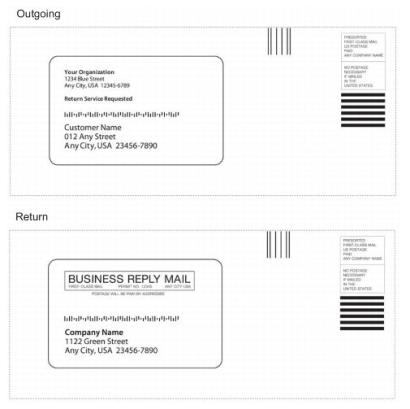
When the permit imprint indicia for USPS Marketing Mail or First-Class Mail is printed on a reusable window envelope intended to be returned as Business Reply Mail (BRM), the imprint “NO POSTAGE NECESSARY IF MAILED IN THE UNITED STATES” must be printed on the envelope directly below the permit imprint indicia. See Exhibit 6.5.4 below. These additional conditions apply:
- The permit imprint indicia must be located in the upper right corner of the address side of the mailpiece.
- The horizontal bars must be printed directly below the “NO POSTAGE NECESSARY” imprint and must not extend below the delivery line of the address.
- The other BRM elements as described in 505.1.5, with the exception of the Facing Identification Mark (FIM), must appear on the insert in the envelope window. The FIM C must be printed on the envelope under 202.8.0.
- The outgoing First-Class Mail portion with two-way indicia must be endorsed “Return Service Requested,” except for mailpieces participating in Address Change Service (ACS). First-Class Mail letters participating in ACS must be endorsed “Change Service Requested” for traditional ACS. Mailpieces with Intelligent Mail barcodes and requesting OneCode ACS must have the printed endorsement “Electronic Service Requested,” but the embedded request must be for “Change Service Requested” (option 1) only. Endorsements must not appear directly below or to the left of the postage area, and must not be visible when the mailpiece is configured for reply purposes (see 507.4.2 and Exhibit 507.1.5.1).
- USPS Marketing Mail with two-way indicia should not be forwarded, and must not be endorsed “Address Service Requested” or “Forwarding Service Requested.”
Exhibit 6.5.4 Outgoing and Return Two-Way Indicia Examples
Effective July 7, 2014, all content applicable to hazardous, restricted, or perishable mail was removed and incorporated into Publication 52, Hazardous, Restricted, and Perishable Mail.
Hazardous material is any article or substance designated by the U.S. Department of Transportation (DOT) as being capable of posing an unreasonable risk to health, safety, and property during transportation. The provisions concerning hazardous material moved to Publication 52, chapter 3, include mailability restrictions and instructions for:
- Explosives.
- Gases.
- Flammable and combustible liquids.
- Flammable solids.
- Organic substances, organic peroxides.
- Toxic substances and infectious substances.
- Radioactive material.
- Corrosives.
- Miscellaneous.
Restricted matter is an article or substance prohibited or limited by title 18 of the U.S. Code. It also includes matter not otherwise restricted by 18 USC 1716(a) because it may, under conditions encountered in the mail, be injurious to life, health, or property. Examples of the type of restricted matter content moved to Publication 52, chapter 4, include:
- Intoxicating liquors.
- Firearms.
- Knives and sharp instruments.
- Liquids, powders and odor-producing materials.
- Motor vehicle master keys and locksmithing devices.
- Controlled substances and drugs.
- Unsolicited promotional samples.
- Instruments for use in animal fighting ventures.
- Cigarettes, smokeless tobacco, and electronic nicotine delivery systems (ENDS).
Perishable matter is anything that can deteriorate in the mail and thereby lose value, create a health hazard, or cause an obnoxious odor, nuisance, or disturbance, under ordinary mailing conditions. Mailable perishable matter may be sent at the mailer’s own risk when it is packaged as required and when it can be delivered within appropriate and reasonable time limits to prevent deterioration. Examples of the type of perishable matter content moved to Publication 52, chapter 5, include:
- Animals.
- Fresh foods.
- Eggs.
- Meats and meat products.
- Plants.
- Nonmailable plant pests, injurious animals and illegally taken fish or wildlife.
All mailable hazardous materials must be marked as provided under 202.9.0 and include the applicable labels, markings, and tags, as required in Publication 52, Hazardous, Restricted, and Perishable Mail.
Any otherwise mailable matter that reasonably could be considered a bill, invoice, or statement of account due, but is in fact a solicitation for an order, is nonmailable unless it conforms to 9.1.2 through 9.1.5. A nonconforming solicitation constitutes prima facie evidence of violation of 39 USC 3005. Compliance with this section does not avoid violation of Section 3005 if any part of the solicitation or any information with it misrepresents a material fact to the addressee (e.g., misleading the addressee about the identity of the sender of the solicitation or about the nature or extent of the goods or services offered may be a violation of Section 3005).
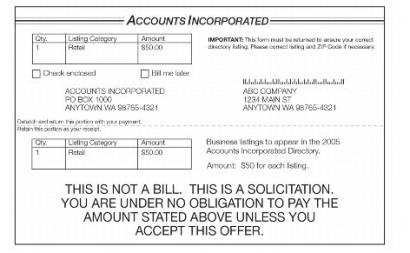
The solicitation must bear on its face either the disclaimer required by 39 USC 3001(d)(2)(A) or the notice: “THIS IS NOT A BILL. THIS IS A SOLICITATION. YOU ARE UNDER NO OBLIGATION TO PAY THE AMOUNT STATED ABOVE UNLESS YOU ACCEPT THIS OFFER.” The statutory disclaimer or the alternative notice must be displayed in conspicuous boldface capital letters of a color prominently contrasting with the background against which it appears, including all other print on the face of the solicitation and that are at least as large, bold, and conspicuous as any other print on the face of the solicitation, but not smaller than 30-point type (see Exhibit 9.1.2). The notice or disclaimer required by this section must be displayed conspicuously apart from other print on the page immediately below each portion of the solicitation that reasonably could be construed to specify a monetary amount due and payable by the recipient. It must not be preceded, followed, or surrounded by words, symbols, or other matter that reduces its conspicuousness or that introduces, modifies, qualifies, or explains the required text, such as “Legal Notice Required by Law.”
Exhibit 9.1.2 Solicitation Disclaimer
The notice or disclaimer must not, by folding or any other device, be made unintelligible or less prominent than any other information on the face of the solicitation.
If a solicitation consists of more than one page or if any page is designed to be separated into portions (e.g., by tearing along a perforated line), the notice or disclaimer required by 9.1.2 must be displayed in its entirety on the face of each page or portion of a page that might be reasonably considered a bill, invoice, or statement of account due as required by 9.1.2.
For this standard, color prominently contrasting excludes any color, or any intensity of an otherwise included color, that does not permit legible reproduction by ordinary office photocopying equipment used under normal operating conditions, and which is not at least as vivid as any other color on the face of the solicitation; and color includes black.
Any solicitation stating that it is approved by the USPS or the Postmaster General or that it conforms to any postal law or regulation is nonmailable.
A solicitation that misrepresents a government entity is nonmailable subject to these conditions:
- Matter that contains a solicitation for products, services, information, or funds that implies any federal government connection, approval, or endorsement through the use of a seal, insignia, reference to the Postmaster General, citation to a federal statute, name of a federal agency, department, or commission, or program, trade, or brand name, or any other term or symbol; or contains any reference to the Postmaster General or a citation to a federal statute that misrepresents either the identity of the mailer or the protection or status afforded such matter by the federal government is nonmailable unless it conforms to 9.2.3. A nonconforming solicitation constitutes prima facie evidence of violation of 39 USC 3005. Compliance with 9.2.3 does not avoid violation of 39 USC 3005 if the solicitation or accompanying information misrepresents material fact such as the nature, value, quantity, quality, or efficacy of the products or services offered for sale, or of the activities of an organization asking for information or monetary contributions.
- Such solicitations must not contain a false representation that federal government benefits or services will be affected by whether or not the recipient makes a purchase or contribution.
- Solicitations for payment for services otherwise available to the recipient free of charge from the federal government are nonmailable unless they contain a clear and conspicuous statement giving notice of that fact.
A solicitation described in 9.2.2a may be mailable if it meets at least one of these conditions (see Exhibit 9.2.3b):
- The solicitation is by a nongovernmental entity that actually has the federal government connection, approval, or endorsement implied by the solicitation’s terms or symbols.
- The solicitation appears in a publication for which the addressee has paid or promised to pay a consideration or which the addressee has otherwise indicated he or she wants to receive, and the solicitation is not on behalf of the publisher of the publication.
Exhibit 9.2.3b Disclaimers for Solicitations Implying Federal Connection
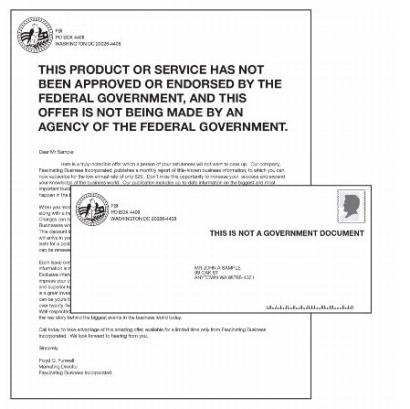
- The solicitation displays the notice required by 9.2.3c1 on the envelope or outside cover or wrapper in which the solicitation is mailed, and one of the two notices required by 9.2.3c2 on the contents. These notices must be printed in boldface capital letters of a color prominently contrasting with the background against which they appear. “Color prominently contrasting” excludes any color or intensity that ordinary photocopying cannot reproduce legibly. The color, which can include black, must be at least as vivid as any other color on the face of the solicitation and its envelope or outside cover or wrapper. The required wording, type size and style, and placement for the notices are as follows:
- On the Envelope, Cover, or Wrapper. The face of the envelope or outside cover or wrapper must bear the notice: “THIS IS NOT A GOVERNMENT DOCUMENT.” The letters for printing this notice must be as large, bold, and conspicuous as any other letters on the face of such envelope, cover, or wrapper, but never smaller than 12-point type. The notice must appear in the upper right quadrant, below the postage stamp or other postage indicia and above the address, and it must be surrounded by a clear space not less than 1/4 inch wide.
- On the Contents. The solicitation mailed within the envelope, cover, or wrapper must bear at the outset on its face one of these two headlines, depending on its purpose as indicated in parentheses: (a) “THIS PRODUCT OR SERVICE HAS NOT BEEN APPROVED OR ENDORSED BY THE FEDERAL GOVERNMENT, AND THIS OFFER IS NOT BEING MADE BY AN AGENCY OF THE FEDERAL GOVERNMENT” (for the purchase of or payment for a product or service); (b) “THIS ORGANIZATION HAS NOT BEEN APPROVED OR ENDORSED BY THE FEDERAL GOVERNMENT, AND THIS OFFER IS NOT BEING MADE BY AN AGENCY OF THE FEDERAL GOVERNMENT” (for information or the contribution of funds or membership fees). The letters for printing these notices must be as large, bold, and conspicuous as any other letters on the face of the solicitation, but never smaller than 30-point type. The notice must be surrounded by a clear space at least 1/2 inch wide. The notice must not be preceded, followed, or surrounded by words, symbols, or other matter that reduces its conspicuousness or introduces, modifies, qualifies, or explains the required text, such as “Notice Required by Law.” The notice must not, by folding or any other device, be made unintelligible or less prominent than any other information on the face of the solicitation.
For this standard, lottery is any scheme or promotion, whether lawful under the laws of any state, which, on paying a consideration, offers a prize dependent in whole or in part on lot or chance.
Unlawful matter includes any letter, newspaper, periodical, parcel, stamped card or postcard, circular, or other matter permitting or facilitating participation in a lottery; any lottery ticket or part thereof or substitute; and any form of payment for a lottery ticket or share.
This standard does not apply to:
- Any fishing contest not conducted for profit, in which prizes are awarded for the species, size, weight, or quality of fish caught by contestants in any bona fide fishing or recreational event (18 USC 1305).
- Mailings, to addresses within a state, of tickets or other material on a lottery conducted by that state under its laws (18 USC 1307).
- Any gaming conducted by an Indian tribe under the Indian Gaming Regulatory Act (25 USC 2720).
- An advertisement, list of prizes, or other information on a lottery not prohibited by the state where it is conducted.
Any advertising, promotional, or sales matter that solicits or induces the mailing of any article described in PUB 52 as hazardous, restricted, or perishable is nonmailable except that such matter relating to controlled substances, radioactive materials, restricted liquids and powders, battery-powered devices, odd-shaped items in envelopes, and switchblade and ballistic knives, as described in PUB 52, is mailable if it contains packaging instructions and any other mailing limitations under PUB 52, 508.9.0, and 508.10.0 (18 USC 1716).
Advertisements for motor vehicle master keys are nonmailable (18 USC 1716A, 39 USC 3002), except to lock manufacturers, professional locksmiths, motor vehicle manufacturers or dealers; and federal, state, or local government agencies.
Matter addressed to a person using a fictitious name, title, or address in conducting, through the mail, any scheme or device in violation of law is nonmailable if:
- After notification, the addressee fails to appear at the Post Office and be identified.
- The fictitious character of such mail is established to the Judicial Officer’s satisfaction in consequence of a proceeding initiated under 39 CFR 953 (18 USC 1342).
Mail of foreign origin is nonmailable if it contains matter determined by a court of competent jurisdiction or by the International Trade Commission to violate the Semiconductor Chip Protection Act of 1984 (17 USC 901-914) or to violate the copyright laws of the United States or any copyright convention or treaty to which the United States is a party (17 USC 601-603).
Matter addressed to foreign countries posted in violation of law or treaty stipulation is nonmailable.
Obscene, lewd, lascivious, or filthy publications or writings, or mail containing information on where, how, or from whom such matter may be obtained, and matter that is otherwise mailable but that has on its wrapper or envelope any indecent, lewd, lascivious, or obscene writing or printing, and any mail containing any filthy, vile, or indecent thing is nonmailable (18 USC 1461, 1463).
Any matter of a character tending to incite arson, murder, assassination, treason, insurrection, or forcible resistance to any law of the United States, or containing any threat to take the life of, or to inflict harm upon, the President of the United States is nonmailable (18 USC 1461, 1717).
Other matter that is nonmailable (18 USC 1717) includes every letter, writing, circular, stamped card or postcard, picture, print, engraving, photograph, newspaper, pamphlet, book, publication, or thing as described in these statutes:
- Forged or altered military or official passes (18 USC 499).
- Matter bearing forged or altered seals of government departments or agencies (18 USC 506).
- Defense information (18 USC 793, 794).
- Documents obtained by persons falsely assuming to be foreign diplomats (18 USC 915).
- False statements influencing foreign governments (18 USC 954).
- Matter relating to a conspiracy to injure property of a foreign government (18 USC 956).
- Matter unlawfully in aid of a foreign government (18 USC 957).
- Matter relating to an expedition against a friendly nation (18 USC 960).
- Matter relating to delivery of an armed vessel to a belligerent nation (18 USC 964).
- Matter wrongfully bearing the seal of a government department or agency (18 USC 1017).
- Forged, altered, or misused passports (18 USC 1543, 1544). Passport applications containing false statements, and passports falsely obtained (18 USC 1542).
- Matter bearing false statements intended to injure Armed Forces during war (18 USC 2388).
This standard does not pertain to written, printed, or graphic matter related to fighting ventures involving live birds if such fight is permitted under the laws of the state in which the fight is to take place (7 U.S.C. 2156). The terms animal, animal fighting venture, and state are defined in PUB 52, part 461. Written, printed, or graphic matter is nonmailable if it:
- advertises an animal for use in an animal fighting venture;
- advertises a knife, a gaff, or any other sharp instrument attached, or designed or intended to be attached, to the leg of a bird for use in an animal fighting venture; or
- promotes or in any other manner furthers an animal fighting venture.
A private identification document without a disclaimer is nonmailable (18 USC 1738; 39 USC 3001(a)). This group includes any document that:
- Is of a type intended or commonly accepted for the identification of individuals;
- Bears a birth date or age purported to be that of the person named in it;
- Is not issued by or under the authority of a government;
- Is deposited in the mail by someone in the business of furnishing, for valuable consideration, documents that meet criteria in 9.5.8a and 9.5.8c;
- Is deposited in the mail to further that business; and
- Is deposited by someone who knows that it fails to carry diagonally printed, clearly and indelibly on both the front and back, “NOT A GOVERNMENT DOCUMENT” in capital letters no smaller than 12-point type.
The term sweepstakes means a game of chance for which no consideration is required to enter.
Sweepstakes matter is mailable only if it discloses all of the following:
- In the body, in the rules, and on the order or entry form that no purchase is necessary.
- In the body, in the rules, and on the order or entry form that a purchase will not increase the odds of winning.
- All terms and conditions, including rules and entry procedures of the sweepstakes.
- The sponsor or mailer, with the principal place of business or address at which the sponsor or mailer may be contacted.
- Sweepstakes rules, including the odds of winning, quantity, value, and nature of the prize and the schedule of any payments over time.
Sweepstakes matter is nonmailable if it does any of the following:
- Represents that individuals not making a purchase may be disqualified from receiving future solicitations.
- Requires that the entry be accompanied by an order or payment for a product or service previously ordered.
- Represents that the recipient has won a prize unless that individual has won such prize.
- Otherwise contradicts or is inconsistent with any disclosure required by 9.6.2, or 9.6.3.
The term skill contest means a puzzle, game, competition, or other contest in which a prize is awarded, the outcome depends upon the skill of the contestant, and for which a payment, purchase, or donation is required to enter.
Skill contests are mailable only if they include all of the following:
- Disclose the terms and conditions of the contest, including the rules and entry procedures.
- Disclose the sponsor or mailer, with the principal place of business or address at which the sponsor or mailer may be contacted.
- Contain rules that state all of the following:
- Number of rounds or levels and the cost to enter each round.
- If subsequent rounds will be more difficult.
- Maximum cost to enter all rounds.
- Number of entrants or percentage expected to correctly solve the contest.
- Identity or qualifications of the judges, if judged by other than the sponsor.
- Method of judging.
- Dates the winners will be determined and the prizes awarded.
- Quantity, value, and nature of the prize.
- Schedule of any payments over time.
A facsimile check is nonmailable unless it states on the face of the check that it is not a negotiable instrument and has no cash value.
Matter described in 9.6, 9.7, and 9.8 is mailable if it appears in a magazine, newspaper, or other periodical if the promotions are not directed to a named individual, or the promotions do not include the opportunity to make a payment or order a product or service.
Any notice or disclaimer required under 9.6, 9.7, and 9.8 shall be clearly and conspicuously displayed. Disclaimers required by 9.6.2a and 9.6.2b must be more conspicuously displayed than any other disclaimer.
In general, any person who uses the mails for any mailing falling under 9.2, 9.6, 9.7, and 9.8 shall adopt reasonable practices or procedures to prevent the mailing of such matter to any person who, personally or through their legal representative, submits a written request that no such matter shall be mailed to that person. Such request may be made either to the mailer, or the Attorney General, or their representative, of the appropriate state. Such requests shall be honored for a period of five years from the date of the request. The mailer shall maintain a record of all such written requests.
Any promoter of sweepstakes or skill contests must make a clear and conspicuous disclosure of the address or toll-free telephone number by which an individual, or their duly authorized representative, may notify a promoter to have that individual‘s name and address removed from all lists of names and addresses used by that promoter to mail any skill contest or sweepstakes. Promoters have 60 days from the date of receipt of the removal request to effect the removal of the name and address from all mailing lists used by that promoter for any skill contest or sweepstakes.
Postmasters are not authorized to decide whether written, printed, or graphic matter is nonmailable based on its content or to deny entry to such matter or exclude it from the mail.
Written, printed, or graphic matter not properly prepared for mailing can be refused.
[7-12-26] A catalog is a bound (stapled, stitched, glued or fastened together along one edge) mailpiece with at least 12 pages, providing an organized listing of products or services offered for sale. A catalog mailpiece may be letter-shaped, flat-shaped or parcel-shaped, and is mailed at USPS Marketing Mail (including Heavy Printed Matter) or Bound Printed Matter rates. The product listing must include Images, photographs or illustrations of the products or services, descriptive details, fulfillment information; and prices, or contain an alternate method for the reader to determine prices. Catalogs must contain enough information to allow an order to be placed, e.g., an order form, a phone number, a web address, or the means to access a web address. Catalogs will also enable fulfillment options for the products or services offered for sale.



