| Publication 52 - Hazardous, Restricted, and Perishable Mail > 3 Hazardous Materials > 34 Mailability by Hazard Class > 346 Toxic Substances and Infectious Substances(Hazard Class 6) Hazard Class 6 consists of two divisions: - Division 6.1, Toxic Substances: This division includes toxic substances, poisons, and material with properties that cause extreme irritation, especially in confined spaces. Examples include bromobenzyl cyanide, methyl bromide, motor fuel anti-knock mixtures, tear gas, and some insecticides and pesticides (not all examples are mailable).
- Division 6.2, Infectious Substances: This division includes infectious substances. Examples include biological products, regulated medical waste, sharps medical waste, used health care products, and forensic materials.
The following terms are used in the standards for Division 6.1 materials: - Toxic Substance: A poisonous material, other than a gas, known to be toxic enough to cause death, injury, or harm to humans if swallowed, inhaled, or brought into contact with skin. These substances are presumed to be toxic to humans because they fall within any one of the following categories when tested on laboratory animals (whenever possible, animal test data that has been reported in the chemical literature should be used to determine toxicity):
- Oral Toxicity: A liquid or solid with an LD50 (lethal dose) for acute oral toxicity of 300 mg/kg or less that is likely to cause death within 14 calendar days in half of the test animals when ingested.
- Dermal Toxicity: A material with an LD50 for acute dermal toxicity of 1,000 mg/kg or less that is likely to cause death within 14 calendar days in half of the test animals when administered by continuous contact with bare skin.
- Inhalation Toxicity: A dust or mist with a lethal concentration (LC50) for acute inhalation toxicity of not more than 4 mg/L, or a saturated vapor concentration in air at 68° F (20° C) greater than or equal to more than one-fifth of the LC50 for acute toxicity on inhalation of vapors and with an LC50 for acute inhalation toxicity of vapors of not more than 5,000 ml/m3 that, when administered by continuous inhalation for 1 hour, is likely to cause death within 14 days in half of the test animals.
- Irritating Material: Any liquid or solid (e.g., tear gas) that emits intense fumes causing severe but reversible localized irritation to the eyes, nose, and throat, temporarily impairing a person‘s ability to function.
Division 6.2 materials include infectious substances, biological products, regulated medical waste, sharps medical waste, used health care products, and forensic materials. Division 6.2 materials are not permitted in international mail or domestic mail, except when they are intended for medical or veterinary use, research, or laboratory certification related to the public health; and only when such materials are properly prepared for mailing to withstand shocks, pressure changes, and other conditions related to ordinary handling in transit. Unless otherwise noted, all mailable Division 6.2 materials must meet the mail preparation requirements for air transportation. The following terms are used in the standards for Division 6.2 materials: - Infectious Substance: A material known or reasonably expected to contain a pathogen. A pathogen is a microorganism that can cause disease in humans or animals. Examples of pathogens include bacteria, viruses, fungi, and other infectious agents. An infectious substance must be assigned to one of the following two packaging categories:
- Category A: An infectious substance transported in a form capable of causing permanent disability or life-threatening or fatal disease in otherwise healthy humans or animals when exposure occurs. Category A infectious substances are nonmailable. A Category A infectious substance is assigned the identification number UN2814 or UN2900, based on the known medical history or symptoms of the source patient or animal, endemic local conditions, or professional judgment concerning the individual circumstances of the source human or animal.
- Category B: An infectious substance that does not meet the criteria for inclusion in Category A. A mailpiece known or suspected to contain a Category B infectious substance must bear the proper shipping name "Biological Substance, Category B" and must be assigned to and marked with identification number UN3373 (as shown in Exhibit 346.12). Regulated medical waste and sharps medical waste must be assigned to and marked with identification number UN3291. The proper shipping name, identification number, and warning label, when applicable, must be marked on the address side of the package unless specified in 221.1 and 325.1. A sack or tub containing Category B infectious substances must have attached PS Tag 44, Sack Contents Warning. The tag must be removed when the Category B infectious substances are no longer in the sack or tub.
Mailpiece Symbol and Marking for Mailpieces Containing Biological Substance, Category B Substances 
- Biological Product: A biological product includes virus, therapeutic serum, toxin, antitoxin, vaccine, blood, blood component or derivative, allergenic product, or similar product, or arsphenamine or any derivative of arsphenamine (or any other trivalent arsenic compounds) intended to prevent, treat, or cure a disease or condition in humans or animals. Biological products also encompass materials regulated under 42 U.S.C. § 262 or 21 U.S.C. § 151-159. Unless otherwise excepted, mailpieces containing biological products known or likely to contain pathogens that meet the definition of a Category B infection substance must be marked with identification number UN3373 (as shown in Exhibit 346.12).
- Cultures: Infectious substances that result from a process by which pathogens are intentionally reproduced, excluding human or animal patient specimens as defined in item e below.
- Exempt Human or Animal Specimen: A human or animal sample (including, but not limited to, secreta, excreta, blood and its components, tissue and tissue fluids, and body parts) transported for routine testing not related to the diagnosis of an infectious disease. Typically, exempt human specimens are specimens for which there is a low probability that the sample is infectious, such as specimens for drug or alcohol testing; cholesterol testing; blood glucose level testing; prostate-specific antigens (PSA) testing; testing to monitor heart, kidney, or liver function; pregnancy testing; and testing for diagnosis of noninfectious diseases such as cancer biopsies. Exempt human or animal specimens are not subject to regulation as hazardous materials but must be packaged according to 346.327.
- Patient Specimen: Material that is collected directly from humans or animals and transported for purposes such as diagnosis and research. Patient specimens include excreta, secreta, blood and its components, tissue and tissue swabs, body parts, and specimens in transport media (such as transwabs, culture media, and blood culture bottles).
- Regulated Medical Waste: Soft medical waste (other than a sharp) derived from the medical treatment, diagnosis, immunization, or biomedical research of a human or animal. Soft medical waste includes items such as used rubber gloves, swabs, gauze, tongue depressors, and other similar material. Mailpieces containing regulated medical waste must be marked with identification number UN3291.
- Sharps Medical Waste: Medical waste objects capable of cutting or penetrating skin or packaging material and that is contaminated with a pathogen or may become contaminated with a pathogen derived from the medical treatment, diagnosis, immunization, or biomedical research of a human or animal. Sharps include used medical waste such as needles, syringes, scalpels, broken glass, culture slides, culture dishes, broken capillary tubes, broken rigid plastic, and exposed ends of dental wires. Mailpieces containing sharps medical waste must be marked with identification number UN3291.
- Toxin: Division 6.1 materials from plant, animal, or bacterial sources. Toxins containing infectious substances (or contained in an infectious substance) are classed under Division 6.2 (described as an infectious substance), and assigned to UN2814, UN2900, or UN3373, as appropriate. Toxins known or suspected to contain a Category A infectious substance is nonmailable. A toxin known or suspected to contain a Category B infectious substance must be marked with identification number UN3373 and packaged according to 346.321. Toxins from plant, animal, or bacterial sources that do not contain an infectious substance and are not contained in an infectious substance may be considered for classification as Division 6.1 toxic substances under 346.
- Used Health Care Product: Medical diagnostic, or research device or piece of equipment, or a personal care product used by consumers, medical professionals, or pharmaceutical providers, that does not meet the definition of a diagnostic specimen, biological product, regulated medical waste, or sharps waste, is contaminated with potentially infectious body fluids or materials, and is not decontaminated or disinfected to remove or mitigate the infectious hazard prior to transport.
The following conditions apply for mailing Division 6.1 toxic substances: - International Mail: Division 6.1 toxic substances or poisons and irritating materials are prohibited.
- Domestic Mail via Air or Surface Transportation: Division 6.1 toxic substance or poison that can qualify as a Limited Quantity/consumer commodity material is permitted when packaged under the applicable requirements in Appendix C (Packaging Instruction 6A). Certain other poisonous materials are permitted to be mailed only between authorized parties under specific conditions as specified in 346.21(b).
The following materials are permitted to be mailed only within the conditions noted: - Limited Quantity: Division 6.1 toxic substances that qualify as a Limited Quantity and are designated as consumer commodity materials are mailable by air or surface transport when all applicable conditions are met.
- Toxic Substances with LD50 Oral Toxicity of 50 mg/kg or Less: Division 6.1 toxic substances having LD50 for oral toxicity greater than 5 mg/kg but less than or equal to 50 mg/kg are mailable only when sent between authorized parties under specified conditions:
- Scientific Use: Toxic substances intended for scientific use (not outwardly or inherently dangerous or injurious to life, health, or property) may be sent only between manufacturers, dealers, bona fide experimental or research laboratories, and employees of federal, state, or local governments designated by the agency head for official use. A Shipper‘s Declaration for Dangerous Goods is required for domestic air transportation.
- Poisonous Drugs and Medicines: Poisonous drugs and medicines may be sent only from manufacturers or dealers to licensed professionals, including physicians, surgeons, dentists, pharmacists, druggists, cosmetologists, barbers, and veterinarians (18 U.S.C. § 1716). In limited cases, prescription drugs may be returned to the manufacturer or its registered agent, as specified in 453.36.
Packaging, marking, labeling, and documentation requirements for mailable toxic substances are as follows: - Toxic Substances with LD50 Oral Toxicity of 50 mg/kg or Less: All applicable requirements in 346.21, as well as Packaging Instruction 6B in Appendix C, must be met. The address side of each mailpiece must be clearly and durably marked with the proper shipping name and UN number of the material (unless exempted by 453.4).
- Air Transportation: Packages containing mailable Class 6 materials must display the DOT diamond-shaped marking, with a black top and bottom, a black border, and a white or contrasting background. A black symbol "Y" must be clearly visible at the center of the diamond-shape. Each mailpiece must also be marked with the proper shipping name ("Consumer Commodity") and identification number ("ID8000"), and display an approved DOT Class 9 hazardous material warning label (refer to Exhibit 325.4(b)). A completed Shipper‘s Declaration for Dangerous Goods, prepared in triplicate, must be affixed to the outside of the mailpiece.
- Surface Transportation: Packages containing mailable Class 6 materials must be plainly and durably marked on the address side with an approved DOT Limited Quantity surface marking (refer to 325.5). Limited Quantity ground markings for surface shipments do not require a shipping name or identification number. Limited Quantity material must meet the applicable requirements specified in 346.21 and (9). Packaging Instruction 6A in Appendix C must be followed.
- Marking Specifications: Markings must be durable, legible, and readily visible, applied to at least one side or end of the outer packaging. The diamond-shaped border must be at least 2 mm in width, with a minimum side dimension of 100 mm, unless the package size necessitates a reduced marking of no less than 50 mm on each side.
Liquids and solids such as pesticides, insecticides, herbicides, and irritating material (346.11(b)), that do not meet the classification criteria of a hazardous material per 49 CFR § 172.101 with an oral LD50 value greater than 300 mg/kg are mailable but must be packaged in rigid outer packaging (refer to 339.4) and be able to withstand normal transit and handling. Liquids must also follow the conditions provided in 451.3(a). The following Division 6.1 materials are nonmailable: - Toxic Substances: Any toxic material with an oral toxicity of LD50 of 50 mg/kg or less is nonmailable, except when sent between authorized parties under the conditions permitted in (9)(b). Examples of nonmailable toxic materials include, but are not limited to, the following:
- Aniline oil (UN1547).
- Bromoacetone (UN1569).
- 3-Chloro-4-methylphenyl isocyanate (UN2236).
- Chloropicrin (UN1580).
- Cyanogen bromide (UN1889).
- Hexaethyl tetraphosphate, liquid or solid (UN1611).
- Hydrocyanic acid aqueous solutions (UN1613).
- Methyl bromide (UN1062).
- Methyl parathion, liquid (NA3018).
- Motor fuel antiknock mixtures (UN1649).
- Organic phosphate compound (NA1955).
- Parathion (NA1967).
- Phenylcarbylamine chloride (UN1672).
- Tetraethyl dithiopyrophosphate (UN1704).
- Tetraethyl lead, liquid (NA1649).
- Tetraethyl pyrophosphate, liquid (NA3018).
- Thiophosgene (UN2474).
- Irritating Materials: All irritating materials are nonmailable. Examples include the following:
- Bromobenzyl cyanide (UN1694).
- Chloroacetophenone (UN1697).
- Diphenylamine chloroarsine (UN1698).
- Diphenylchloroarsine (UN1699).
- Tear gas (UN1700, NA1693, and UN1693), except for those containing oleoresin capsicum.
The following apply: - Conditions for mailing Division 6.2 infectious substances:
- International Mail: Category A infectious substances are nonmailable. Category B infectious substances (as defined in 346.12(a)2) are permitted when they are intended for medical or veterinary use, research, or laboratory certification related to public health, and are properly prepared for mailing. The mailer must receive written approval from the director, Product Classification. (Refer to 214 for contact information). See 622.2 and Mailing Standards of the United States Postal Service, International Mail Manual (IMM), section 135, for specific requirements.
- Domestic Mail: Infectious substances are mailable only when intended for medical or veterinary use, research, or laboratory certification related to public health, and must be properly prepared to withstand shocks, pressure changes, and other conditions incident to ordinary handling in transit. The following substances are mailable subject to the corresponding packaging requirements:
- Category B Infectious Substance: Packaging Instruction 6C.
- Sharps and Other Mailable Regulated Medical Waste: Packaging Instruction 6D.
- Used Health Care Products: Packaging Instruction 6E.
- Forensic Materials: Packaging Instruction 6F.
- Nonregulated Materials: Packaging Instruction 6G.
- Exempt Human or Animal Specimens: Packaging Instruction 6H.
- Special conditions: The following items are permitted to be mailed within specific quantity limits and packaging conditions specified in 346.3:
- Infectious substances.
- Biological products.
- Cultures and stocks.
- Exempt human or animal specimens.
- Patient specimens.
- Regulated medical waste.
- Sharps medical waste.
- Toxins.
- Used health care products.
The proper packaging, marking, labeling, and documentation for mailable Division 6.2 materials are described in the following sections. All mailable materials, as identified in 346.3, must be packaged in accordance with specified guidelines to ensure safe transit. Exhibit 346.32 provides the relevant reference within 346 for the proper packaging requirements of each type of mailable material.
Note: Refer to Packaging Instruction 6C in Appendix C. Regulated medical waste and sharps medical waste containing or suspected to contain a Category A infectious substance is not mailable. Category B infectious substances that meet the definition in 346.12(a)2 require triple packaging, must adhere to the packaging requirements in 49 CFR § 173.199, and be shipped via Priority Mail or Priority Mail Express. Packaging specifics include the following: - Primary Receptacles: Each primary receptacle containing a liquid must be leakproof and surrounded by material sufficient to protect the primary receptacle and absorb the total amount of liquid in case of leakage or breakage. Receptacles containing solids must be sift-proof. Each receptacle may hold up to 1 liter (34 ounces) for liquids or 4 kg (8.8 pounds) of solids.
- Secondary Packaging: Secondary packaging for liquids must be leakproof. Secondary containers for solids must be sift-proof. The primary receptacle(s) and secondary packaging must be enclosed in a rigid outer packaging. Two or more primary receptacles, totaling no more than 4 liters (1 gallon) of liquid or 4 kg (8.8 pounds) of solids, may be enclosed in a single secondary packaging.
- Biohazard Symbol: The secondary packaging must be marked with the international biohazard symbol shown in Exhibit 346.321
- Pressure Standards: The primary receptacle or secondary packaging must be capable of withstanding, without leakage, an internal pressure differential of no less than 95 kPa (0.95 bar, 14 psi) across a temperature range of -40° F to 130° F (-40° C to 55° C).
- Marking Requirements: Mailpieces sent under 346.321 must be marked with the shipping name "Biological Substance, Category B" and "UN3373" in accordance with 49 CFR § 173.199(a)(5) and as shown in Exhibit 346.12 (on the address side of the package unless specified in 221.1 and 325.1). Regulated medical waste and sharps medical waste, defined in 346.12(f) and 346.12(g), must be marked with identification number UN3291. Refer to 346.322 for additional guidance.
- Orientation Arrows: Orientation arrows are not required on these mailpieces but may be included.
- Contact Information: The outer packaging must display the name and telephone number of a person with comprehensive emergency response and incident mitigation knowledge about the shipped material, or of someone who can provide immediate access to the person with such information.
International Biohazard Symbol 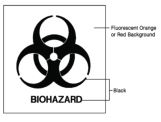
Note: Refer to Packaging Instructions 6D in Appendix C. Regulated medical waste and sharps medical waste containing or suspected to contain a Category A infectious substance is not mailable. Regulated medical waste and sharps medical waste as defined in 346.12(f) and 346.12(g) and containing materials classified as Category B infectious substances must be marked UN3291 and are permitted for mailing only using USPS Returns Service (refer to DMM 505.3) via USPS Ground Advantage service. The following requirements apply: - Authorization: Vendors providing complete medical waste or sharps waste mailing container systems (including all component parts required to safely mail such waste to a storage or disposal facility) must obtain authorization from the Postal Service prior to mailing. Before applying for authorization, each type of mailing container system must be tested and certified under the standards in 346.322(d) by an independent testing facility. Authorization requests must be sent to the director, Product Classification at Postal Service Headquarters (refer to 214 for address), and must include:
- An irrevocable $50,000 surety bond or letter of credit as proof of sufficient financial responsibility to cover disposal costs if the vendor ceases doing business before all its waste container systems are disposed of or to cover cleanup costs if spills occur while the containers are in Postal Service possession.
- The surety bond or letter of credit must be issued in the name of the vendor seeking the authorization and must name the Postal Service as the beneficiary or obligee.
- Vendors must provide a list of distributors, including firm names, addresses, and telephone numbers, to the Postal Service on request. Vendors who market their containers to distributors are responsible for disposal and cleanup costs attributed to those containers.
- Vendor‘s headquarters or business office address.
- Name, address, and phone number of each storage and disposal site.
- List of all types of mailing container systems to be covered by the request, complete samples of each mailing container system, and proof of package testing certifications performed by the independent testing facility that subjected the packaging materials to the testing requirements in 346.322(d).
- A copy of the proposed shipping paper to be used with each mailing container system.
- A 24-hour toll-free telephone number for emergencies.
- List of the types of waste to be mailed for disposal in each mailing container system.
- A copy of the USPS Returns service label specifying that USPS Ground Advantage be used with each mailing container system.
- Address of the Post Office or postage-due unit where the containers are delivered.
- Packaging Requirements: Regulated medical waste and sharps medical waste that also meet the definition of a Category A infectious substance are nonmailable, except for medical professional packages identified in 346.322(b)6, which may not weigh more than 35 pounds. Medical waste materials treated - through steam sterilization, chemical disinfections, or other appropriate methods - to remove Category A or Category B infectious substance must be packaged in accordance with 346.325. The packaging for regulated medical waste and sharps medical waste containing or suspected of containing a Category B infectious substance is subject to the following standards:
- Primary Receptacle: Primary receptacles must be rigid, securely sealed, leakproof, and puncture-resistant (for sharps) with a maximum capacity of 3 gallons for sharps and 5 gallons for waste. They may contain up to 50 ml (1.66 ounces) of residual waste liquid. Each primary receptacle must display the international biohazard symbol shown in Exhibit 346.321. Package testing results must confirm that the contents did not penetrate through the primary receptacle during package testing and that the primary receptacle can maintain its integrity at temperatures as low as 0°F and as high as 120° F (-18° C to 49° C).
- Secondary Packaging: The primary receptacle must be enclosed within a watertight secondary packaging or containment system, which may consist of multiple components. If one of the components is a plastic bag, it must be at least 4 mil thick and combined with a fiberboard box; a plastic bag by itself does not suffice. Multiple primary receptacles may be enclosed within one secondary packaging but must securely hold them to prevent breakage during ordinary processing. The secondary packaging must then be placed within a strong outer packaging constructed of 200-pound grade corrugated fiberboard. Joints and flaps on the outer packaging must be securely fastened with water-resistant tape, glue, or stitching to maintain the integrity of the packaging. Fiberboard boxes with interlock bottom flaps (i.e., easy-fold) are not permitted as outer packaging unless reinforced with water-resistant tape. The secondary packaging must fit securely and snugly within the outer packaging to prevent breakage during ordinary processing.
- Absorbent Material: Absorbent material must be included within each primary receptacle and retain three times the total liquid allowed in the primary receptacle (150 ml per primary receptacle) in case of leakage.
- Weight Limits: Each mailpiece must not exceed 25 pounds, with the exception of Medical Professional Packages (as identified in 346.322(b)6), which may weigh up to 35 pounds. The maximum allowable weight must be printed on the exterior of the packaging and on the assembly and closure instructions included with each mailpiece. Each mailpiece must be tested at the identified maximum allowable weight.
- Assembly Instructions: Each mailing container system must include a step-by-step instruction sheet from the vendor detailing the proper sequence and method of container system assembly prior to mailing to prevent failure due to improper assembly. The instruction sheet must also include a customer service telephone number or provide specific information that directs users to locate such information elsewhere on the container system.
- Medical Professional Packages: Intended primarily for small medical offices, though not restricted to such use, these packages may use one primary receptacle larger than 5 gallons to mail pre-primary sharps receptacles (i.e., sharps receptacles normally used in doctors‘ offices) and other regulated medical waste under the following conditions:
- Compliance Requirements: The mailpiece must meet all requirements in 346.32 except the primary receptacle capacity limits of 346.322(b)1.
- Pre-Primary Sharps Receptacles: Only rigid, securely closed, puncture- and leak-resistant pre-primary sharps receptacles that meet or exceed Occupational Safety and Health Administration (OSHA) standards as identified in 29 CFR § 1910.1030 may be placed inside the primary receptacle. Each pre-primary sharps container may contain no more than 50 ml (1.66 ounces) of residual waste liquid. Several pre-primary sharps receptacles may be enclosed in the single primary receptacle.
- Bagged Waste: Multiple tie-closed plastic bags containing regulated medical waste may be placed within the primary receptacle.
- Liner and Absorbent Material: The primary receptacle must be lined with a plastic bag at least 4 mil thick and must include sufficient absorbent material to absorb all residual liquid in the primary receptacle.
- Weight Limit: The total weight of the mailpiece must not exceed 35 pounds.
- Mailpiece Labeling, Marking, and Documentation: Regulated medical waste and sharps waste must meet the following requirements:
- Labeling of Primary Receptacle and Outer Packaging: Each primary receptacle and outer packaging must display a securely affixed, non-detachable label that includes:
- The vendor‘s company name (as indicated in 346.322(a)).
- The USPS Authorization Number.
- The container ID number or unique model number confirming that the packaging material is certified and that the vendor obtained the authorization required by 346.322(a).
- Labels placed on the top or side of the packaging.
- Biohazard Symbol: Both the primary receptacle(s) and the outer packaging must display the international biohazard symbol in black with a fluorescent orange or fluorescent red background as shown in Exhibit 346.321. The symbol on the outer packaging must measure at least 3 inches high and 4 inches wide.
- Waste Shipping Paper: Each mailpiece must have a four-part waste shipping paper, which must be affixed to the outside of the mailpiece within an envelope or similar carrier that allows easy opening and resealing for document review. The shipping paper must comply with all applicable requirements imposed by the laws of the state from which the container system is mailed. At minimum, the information in Exhibit 346.322 must be included.
- USPS Returns Service Label: The outer packaging must display a properly prepared USPS Returns service label (refer to DMM section 505.3) specifying USPS Ground Advantage. The account must be in the same name as the authorized medical-waste vendor.
- Package Orientation Marking: The outer packaging must display orientation markings on two opposite side walls per 49 CFR § 173.312, indicating the upright position of the mailpiece for proper handling.
- Shipping Name and UN Number Marking: Containers holding regulated medical waste or sharps waste must be marked with the correct UN number and proper shipping name (e.g., "Regulated Medical Waste, UN3291" or "Regulated Medical Waste-Sharps, UN3291"). The shipping name, identification number, and any warning labels (if applicable) must appear on the address side of the package unless specified in 221.1 and 325.1.
- Vendor Retrieval of Held Mailpieces: Vendors are responsible for retrieving mailpieces held at processing facilities due to issues such as improper labeling (e.g. missing return address) or improperly completed Shippers‘ Declarations for Dangerous Goods.
- Medical Professional Packaging Marking: For medical professional packages, the additional marking "Medical Professional Packaging" must be clearly printed on the address side of the outer packaging in lettering at least 2 inches high.
Shipping Paper for Regulated Medical Waste and Sharps Waste Containers Section | Information Required | - Generator (Mailer)
| - Name.
- Complete address (not a Post Office box).
- Telephone number.
- Description of contents of mailing container. “Regulated Medical Waste” or “Regulated Medical Waste-Sharps” is required as appropriate.
- Date container was mailed.
- State permit number of approved facility in which contents are to be disposed of.
| - Destination Facility (Disposal Site)
| Complete address (not a Post Office box). | - Generator’s (Mailer’s) Certification
| The following certification statement must be printed on the shipping paper: “I certify that this container has been approved for the mailing of [insert either
“regulated medical waste” or “sharps waste,” as appropriate], has been
prepared for mailing in accordance with the directions for that purpose, and
does not contain excess liquid or nonmailable material in violation of the
applicable Postal Service regulations. I AM AWARE THAT FULL
RESPONSIBILITY RESTS WITH THE GENERATOR (MAILER) FOR ANY
VIOLATION OF 18 U.S.C. § 1716 WHICH MAY RESULT FROM PLACING
IMPROPERLY PACKAGED ITEMS IN THE MAIL. I also certify that the contents
of this consignment are fully and accurately described above by proper shipping
name and are classified, packed, marked, and labeled, and in proper condition
for carriage by air according to the national governmental regulations.” This statement must be followed by printed or typewritten name of generator (mailer), signature of generator, and date signed. | - Destination Facility (Storage or Disposal Site)
| The following certification statement of receipt, treatment, and disposal must be printed on the shipping paper: “I certify that the contents of this container have been received, treated, and
disposed of in accordance with all local, state, and federal regulations.” This statement must be followed by printed or typewritten name of an authorized recipient at destination facility, signature of authorized recipient, and date signed. | - Transporter Intermediate Handler Other Than the Postal Service (If Different From Destination Facility)
| - Name.
- Complete address (not a Post Office box).
- Printed or typewritten name of transporter or intermediate handler.
- Signature of transporter or intermediate handler and date signed.
| - Serialized Shipping Papers
| Each waste shipping paper or mail disposal service shipping record must be serialized using a unique numbering system for identification purposes. | - Comment Area
| Each shipping paper must contain an area designated for entering comments or noting discrepancies. | - Completion and Distribution of Shipping Paper
| Each shipping paper must contain instructions for properly completing the four-part form. Copies of the form must be distributed as follows: - One copy must be kept by generator (mailer).
- One copy must be kept by transporter or intermediate handler for 90 days.
- One copy must be kept by destination facility for 90 days.
- One copy must be mailed to generator by destination facility.
| - Emergency Telephone Number
| Each shipping paper must bear the following statement with appropriate information: “IN CASE OF EMERGENCY, OR THE DISCOVERY OF DAMAGE OR LEAKAGE,
CALL 1–800-###-####.” |
- Package Testing: Vendors must submit package-testing results from an independent testing facility to the director, Product Classification (refer to 214 for contact information) for each package for which they are requesting authorization. In addition, vendors must submit package testing results from an independent testing facility either when the design of a container system changes or every 24 months, whichever occurs first. The test results must demonstrate that, if subjected to the environmental conditions and test requirements in 49 CFR and 346.322(e), no mailpiece contents would be released into the environment and the package‘s effectiveness would remain intact. The Postal Service may require proof of accreditation or other documentation validating the independent testing facility‘s credentials. Packages intended for approval as medical professional packages may not be tested using pre-primary receptacles that are currently or have previously been approved as Postal Service primary receptacles. Test reports must identify the brand name of the pre-primary receptacles used during testing.
- Testing Criteria: Each mailpiece must pass the following tests:
- Leakproof Test: One primary receptacle with the lid secured and without secondary or outer packaging. The test duration must be at least 5 minutes and must be conducted at 20 kPa (3 psi). The pass/fail criterion is as follows: no air leakage from anywhere other than the closure of the primary receptacle, provided primary receptacle passes the watertightness test. The watertightness test involves placing 50 ml of deionized water in the primary receptacle, securing the closure, and then turning the packaging on its side to check for any evidence of leakage. Any evidence of water leaking from the primary receptacle constitutes failure.
- Stacking Test: One mailpiece must pass the stacking test in 49 CFR § 178.606. A dynamic compression test is applied to the empty, unsealed mailpiece, without primary receptacles, and with the maximum weight marked on the outer packaging and instructions. A factor of 1.5 is used to calculate the test load. The pass/fail criteria is as follows: no sidewall buckling sufficient to damage the primary receptacle‘s contents; maximum deflection is 1 inch.
- Vibration Test: One mailpiece must pass the vibration test in 49 CFR § 178.608.
- The test mailpiece is filled with sharps or other regulated medical waste to the maximum vendor-identified weight, not to exceed 25 pounds (35 pounds for medical professional packages), as specified on the outer packaging and on the assembly and closing instructions.
- The sample is prepared as it would be for mailing.
- The pass/fail criterion is as follows: No rupture, cracking, or splitting of any primary receptacle.
- Wet Drop Test: Five mailpieces must pass the wet drop test in 49 CFR § 178.609e.
- Each test mailpiece is prepared as it would be for mailing and filled with sharps or other regulated medical waste to the maximum vendor-identified weight, not to exceed 25 pounds (35 pounds for medical professional packages), as specified on the outer packaging and on the assembly and closing instructions.
- Each mailpiece undergoes a water spray treatment, and individual mailpieces are tested by drop orientation (top, longest side, shortest side, and corner).
- The pass/fail criteria are as follows: No rupture, cracking, splitting or penetration of contents through the body or lid of any primary receptacle.
- Cold Drop Test: Five mailpieces must pass the cold drop test in 49 CFR § 178.609f.
- The test mailpiece is prepared as it would be for mailing and filled with sharps or other regulated medical waste to the maximum vendor-identified weight, not to exceed 25 pounds (35 pounds for medical professional packages), as specified on the outer packaging and on the assembly and closing instructions.
- Each mailpiece chilled as described in the test and individual mailpieces are tested by drop orientation (top, longest side, shortest side, and corner).
- The pass/fail criteria are as follows: No rupture, cracking, splitting, or penetration of contents through the body or lid of any primary receptacle.
- Impact Test: One mailpiece must pass the test in 49 CFR § 178.609h.
- The test mailpiece is prepared as it would be for mailing and filled with sharps or other regulated medical waste to the maximum vendor-identified weight, not to exceed 25 pounds (35 pounds for medical professional packages), as specified on the outer packaging and on the assembly and closing instructions.
- The pass/fail criteria are as follows: No rupture, cracking, splitting or penetration of contents through the body or lid of any primary receptacle.
- Puncture-Resistant Test: Package testing results must demonstrate that, during all the previous tests, the contents did not penetrate through the primary receptacle.
- Temperature Test: Package testing results must demonstrate that each primary receptacle maintained its integrity when exposed to temperatures as low as 0° F and as high as 120° F (-18° C to 49° C).
- Absorbency Test: Package testing results must demonstrate that the primary receptacle(s) contain enough absorbent material to absorb three times the total liquid allowed within the primary receptacle in case of leakage. Absorbency is confirmed by pouring 150 ml of deionized water into the primary receptacle(s), turning them upside down, and ensuring no free liquid remains unabsorbed. Any evidence of free liquid constitutes failure.
- Watertight Test: Package testing results must demonstrate that no leakage occurred when 50 ml of deionized water was placed into the secondary containment system and the entire system was turned upside down for 5 minutes.
- Suspension of Authorization: The Postal Service reserves the right to suspend a vendor‘s authorization if it determines that a mailpiece no longer meets the standards for mailing sharps medical waste and regulated medical waste containers, or if it poses an unreasonable safety risk to Postal Service employees, Postal Service networks, or the public. The suspension can take effect immediately, rendering the mailpiece nonmailable. The vendor has 7 calendar days from the suspension letter date to contest the decision by writing to the director, Product Classification (refer to 214 for contact information) and providing evidence supporting reconsideration. Any suspension order remains in effect throughout an appeal or challenge process.
Upon notification of suspension of authorization to mail sharps or regulated medical waste containers, the vendor must immediately: - Recall all identified containers
- Notify all customers that mailing of the identified containers is prohibited.
- Suspend sales and distribution of all identified containers.
- Collect the identified containers from distributors, consumers, and the Postal Service without using the mail and in accordance with all federal and state regulations.
Note: Refer to Packaging Instruction 6E in Appendix C. A used health care product containing or reasonably suspected to contain a Category A material is nonmailable. However, a used health care product not suspected to contain an infectious material, or that is known or suspected to contain a Category B infectious substance and is being returned to the manufacturer or manufacturer‘s designee, is mailable with Priority Mail or Priority Mail Express, provided it meets the following packaging requirements: - Primary Receptacle Requirements: Each used health care product must be drained of liquid to the extent possible and placed in a watertight primary receptacle designed and constructed to remain intact under normal transport conditions. If the product can cut or penetrate skin or packaging material, the primary receptacle must be puncture-resistant and capable of securely retaining the product under normal transport conditions. The primary receptacle must be marked with the international biohazard symbol shown in Exhibit 346.321.
- Secondary Packaging Requirements: Each primary receptacle must be enclosed within a watertight secondary packaging designed and constructed to remain intact under normal transport conditions. The secondary packaging must also be marked with the international biohazard symbol shown in Exhibit 346.321.
- Outer Packaging Requirements: The secondary packaging must be placed within an outer packaging with sufficient cushioning material to prevent movement between the secondary packaging and the outer packaging. An itemized list of the contents of the primary receptacle and information concerning possible contamination with a Division 6.2 material, including its possible location on the product, must be placed between the secondary packaging and the outer packaging. Shipping documentation and a content marking on the outer packaging is not required.
Note: Refer to Packaging Instruction 6F in Appendix C. Forensic material containing a biological material (e.g., tissue, body fluid, excreta, secreta) sent on behalf of federal, state, local, or Indian tribal government agencies must be packaged in accordance with 346.325 if it is not known or suspected to contain a Category A or Category B infectious substance. Forensic material containing or suspected to contain a Category A infectious substance is nonmailable. Forensic material containing or suspected to contain a Category B infectious substance, as defined in 346.321, is mailable via Priority Mail or Priority Mail Express when triple-packaged in a primary receptacle, secondary packaging, and a rigid outer packaging as specified below: - Primary Receptacle Requirements: The forensic material must be placed in a securely sealed primary receptacle, surrounded by absorbent material (for liquids) and cushioning to prevent breakage. The absorbent material must be sufficient to absorb the entire liquid contents in case of leakage. The primary receptacle must be marked with the international biohazard symbol shown in Exhibit 346.321.
- Secondary Packaging Requirements: The primary receptacle, along with the absorbent and cushioning material, must be enclosed in a watertight and securely sealed secondary packaging that also displays the international biohazard symbol shown in Exhibit 346.321.
- Outer Packaging Requirements: The secondary packaging must be snugly packed within a strong, rigid outer packaging that is securely sealed. Shipping documentation and a content marking on the outer packaging is not required.
The following materials are not regulated as Division 6.2 hazardous materials and are mailable when the packaging requirements specified in Packaging Instruction 6G in Appendix C are met: - Biological Products: Includes experimental or investigational products subject to federal approval, permit, review, or licensing requirements (e.g., Food and Drug Administration or the U.S. Department of Agriculture). Products known or suspected to contain a Category B infectious substance must be marked with identification number UN3373 (as shown in Exhibit 346.321) and packaged per 346.321. Biological products known or suspected to contain a Category A infectious substance are nonmailable.
- Blood and Blood Components: Includes blood, plasma, plasma derivatives, blood components, tissues, or organs for transplants, and other human cell-based products regulated under the Public Health Service Act (42 U.S.C. § 264-272) or the Food, Drug, and Cosmetic Act (21 U.S.C. § 332 et seq.).
- Blood Samples for Testing: Blood, plasma, and components collected for blood transfusion or the preparation of blood products and sent for testing as part of the collection process are mailable unless believed to contain a Category B infectious substance, in which case it must be shipped as a Category B infectious substance. Materials known or suspected to contain a Category A infectious substance are nonmailable.
- Dried Blood Spots and Fecal Occult Blood Detection Specimens: These materials are not classified as exempt human or animal specimens and are mailable.
- Forensic Materials: Biological materials (e.g., tissue, body fluid, excreta, or secreta) transported on behalf of federal, state, local, or Indian tribal government agencies are mailable if not expected to contain a Category A or Category B infectious substance. Forensic materials known or suspected to contain a Category B infectious substance must be shipped as a Category B infectious substance; those known or suspected to contain a Category A infectious substance are nonmailable.
Note: Refer to Packaging Instruction 6G in Appendix C. Nonregulated materials, as defined in 346.325, are not classified as hazardous, but must be properly packaged when mailed. Regulated medical waste and sharps medical waste must be packaged and mailed under 346.322; used health care products must be packaged and mailed under 346.323; and exempt human and animal specimens must be packaged and mailed under 346.327. All nonregulated materials must be placed within a securely sealed primary receptacle surrounded by sufficient absorbent material (for liquids) and cushioning to prevent breakage. The absorbent material must be sufficient to absorb the entire liquid contents in case of leakage. Either the primary receptacle or the inner packaging must be marked with the international biohazard symbol shown in Exhibit 346.321. The primary receptacle, along with the absorbent and cushioning material, must be enclosed within a strong, rigid outer packaging that is securely sealed. Shipping documentation and a content marking on the outer packaging is not required. Nonregulated material specimens and biological products are subject to the following packaging standards: - Liquid Patient Specimens and Biological Products: Liquid nonregulated patient specimens, forensic specimens, or biological products (e.g., polio vaccine) must be packaged as follows:
- Not Exceeding 50 ml: A specimen or biological product totaling 50 ml or less per mailpiece must be packaged in a securely sealed primary receptacle. Multiple primary receptacles may be enclosed within a single mailpiece, provided the combined volume does not exceed 50 ml.
- Primary Receptacle Requirements: Each primary receptacle must be surrounded by material sufficient to protect it and absorb the total amount of liquid in case of leakage or breakage.
- Secondary Packaging Requirements: The primary receptacle(s), along with the absorbent and cushioning material, must be enclosed in a secondary packaging with a securely sealed, leakproof barrier that can prevent failure of the secondary packaging if the primary receptacle(s) should leak during transport. The secondary packaging must be marked with the international biohazard symbol shown in Exhibit 346.321, except when the secondary packaging also serves as the outer packaging.
- Outer Packaging Requirements: The secondary packaging may serve as the outer packaging if it has sufficient strength to withstand ordinary postal processing. If the secondary packaging serves as the outer packaging, the biohazard symbol must appear on the inner packaging or on the primary receptacle. Shipping documentation and a content marking on the outer packaging is not required.
- Exceeding 50 ml: A liquid patient specimen, forensic material, or biological product exceeding 50 ml per mailpiece must be packaged in a securely sealed primary receptacle. A single primary receptacle must not contain more than 500 ml of specimen; multiple primary receptacles may be enclosed in a single secondary packaging, provided the combined volume does not exceed 500 ml.
- Primary Receptacle Requirements: Each primary receptacle must be surrounded by material sufficient to protect it and absorb the total amount of liquid in case of leakage or breakage.
- Secondary Packaging Requirements: The primary receptacle(s), along with the absorbent and cushioning material, must be enclosed in a secondary packaging with a securely sealed, leakproof barrier that can prevent failure of the secondary packaging if the primary receptacle(s) should leak during transport. The secondary packaging must be securely and snugly enclosed in a fiberboard box (or container of equivalent strength as the outer packaging) and be marked with the international biohazard symbol shown in Exhibit 346.321.
- Outer Packaging Requirements: The secondary packaging cannot serve as the outer packaging. Shipping documentation and a content marking on the outer packaging is not required.
- Solid or Dry Specimen: Solid or dry specimens (e.g., saliva swab, blood spot, fecal smear, culture or stock, forensic material) must be completely dried before packaging in a mailing container or envelope.
- Primary Receptacle Requirements: If used, a breakable primary receptacle must be surrounded by material sufficient to protect it from shock and pressure changes. When required, the cushioning material must surround the primary receptacle.
- Secondary Packaging Requirements: The primary receptacle(s), along with the absorbent and cushioning material, must be enclosed in a secondary packaging with a securely sealed, sift-proof barrier that can prevent failure of the secondary packaging if the primary receptacle(s) should break during transport. The secondary packaging must be securely sealed and be marked with the international biohazard symbol shown in Exhibit 346.321, except when the secondary packaging also serves as the outer packaging.
- Outer Packaging Requirements: The secondary packaging may serve as the outer packaging if it has sufficient strength to withstand ordinary postal processing. If the secondary packaging serves as the outer packaging, the biohazard symbol must appear on the inner packaging or on the primary receptacle. Shipping documentation and a content marking on the outer packaging is not required.
Note: Refer to Packaging Instruction 6H in Appendix C. Exempt human or animal specimens as defined in 346.12(d), are not regulated as hazardous materials but must be packaged to meet mailing standards, including being triple-packaged (i.e., with primary receptacle, secondary packaging, and outer packaging). The requirements for this packaging are as follows. - Primary Receptacle Requirements: A single primary receptacle must not contain more than 500 milliliters (ml) of a liquid specimen or 500 grams of a solid specimen. Multiple primary receptacles may be enclosed within a single secondary packaging, provided the combined volume does not exceed 500 ml (for liquids) or 500 grams (for solids). Each primary receptacle must be leakproof or sift proof and individually wrapped or separated with material sufficient to protect it and contain or absorb the total amount of liquid or solid in case of leakage or breakage.
- Secondary Packaging Requirements: The primary receptacle(s), along with the absorbent and cushioning material, must be enclosed in a secondary packaging with a securely sealed, leakproof (for liquids) or sift-proof (for solids) barrier that can prevent failure of the secondary packaging if the primary receptacle(s) should break during transport. The secondary packaging must be securely and snugly enclosed in a fiberboard box (or container of equivalent strength as the outer packaging) and be marked with the international biohazard symbol shown in Exhibit 346.321.
- Outer Packaging Requirements: The primary and secondary packaging must be enclosed in a strong, rigid outer packaging; the secondary packaging cannot serve as the outer packaging. At least one side of the outer packaging must measure a minimum of 3.9 inches by 3.9 inches (100 mm by 100 mm). The outer packaging must be marked on the address side with the words "Exempt human specimen" or "Exempt animal specimen," as appropriate. Shipping documentation and a content marking on the outer packaging is not required.
The following Division 6.2 materials are nonmailable: - Blood for Transfusion: Blood collected for transfusion and known or suspected to contain a Category A infectious substance.
- Biological Products and Specimens: Biological products, cultures, stocks, or other biological specimens known or suspected to contain a Category A infectious substance. Mailpieces exceeding 4 liters (1 gallon) for liquids or 4 kg. (8.8 pounds) for solids are nonmailable.
- Toxins: Toxins known or suspected to contain a Category A infectious substance. Sharps and Regulated Medical Waste: Sharps medical waste and regulated medical waste containing a Category A infectious substance.
- Sharps and Regulated Medical Waste: Sharps medical waste and regulated medical waste containing a Category A infectious substance.
- Used Healthcare Products: Used healthcare products containing a Category A infectious substance.
If a mailpiece is found containing a nonmailable Class 6 material, or is damaged or leaking during Postal Service handling, the incident must be reported and handled in accordance with POM 139.117 (for immediate threats to persons or property) and 139.118 (if no immediate threat is present). Refer to Handbook EL-812, Hazardous Materials and Spill Response (refer to Part VII, "Response to Hazardous Material Incidents and Emergencies," under "Hazardous Materials Incident Reports") for additional handling information. The local Postal Service safety officer (or designee) must immediately initiate the spill response procedures in Handbook EL-812. For spills involving infectious substances (etiologic agents), the following containment and cleanup steps must also be followed: - Glove Use: Rubber gloves are required throughout the cleanup procedure.
- Absorbent Material: The leaking package must be surrounded by absorbent material.
- Secondary Containment: The leaking package must be placed within another box and securely sealed.
- Bagging and Sealing: The sealed box must then be placed inside a plastic bag and sealed.
- Surface Decontamination: Affected surfaces and gloves must be rinsed with household chlorine bleach, diluted to 1 ounce to 1 gallon of water, and left to stand for 5 minutes. Since chlorine bleach is mildly corrosive, caution is advised. Surfaces must be wiped dry with an absorbent material, which is then bagged and incinerated.
- CDC Reporting: The Centers for Disease Control and Prevention (CDC) must be notified of the damaged package (404-633-5313).
- Proper Disposal: Etiologic agents must not be disposed of in regular trash. Disposal guidance should be sought from the area environmental compliance specialist.
|



